
Robotics in Chemical Plants: Improving Safety and Efficiency
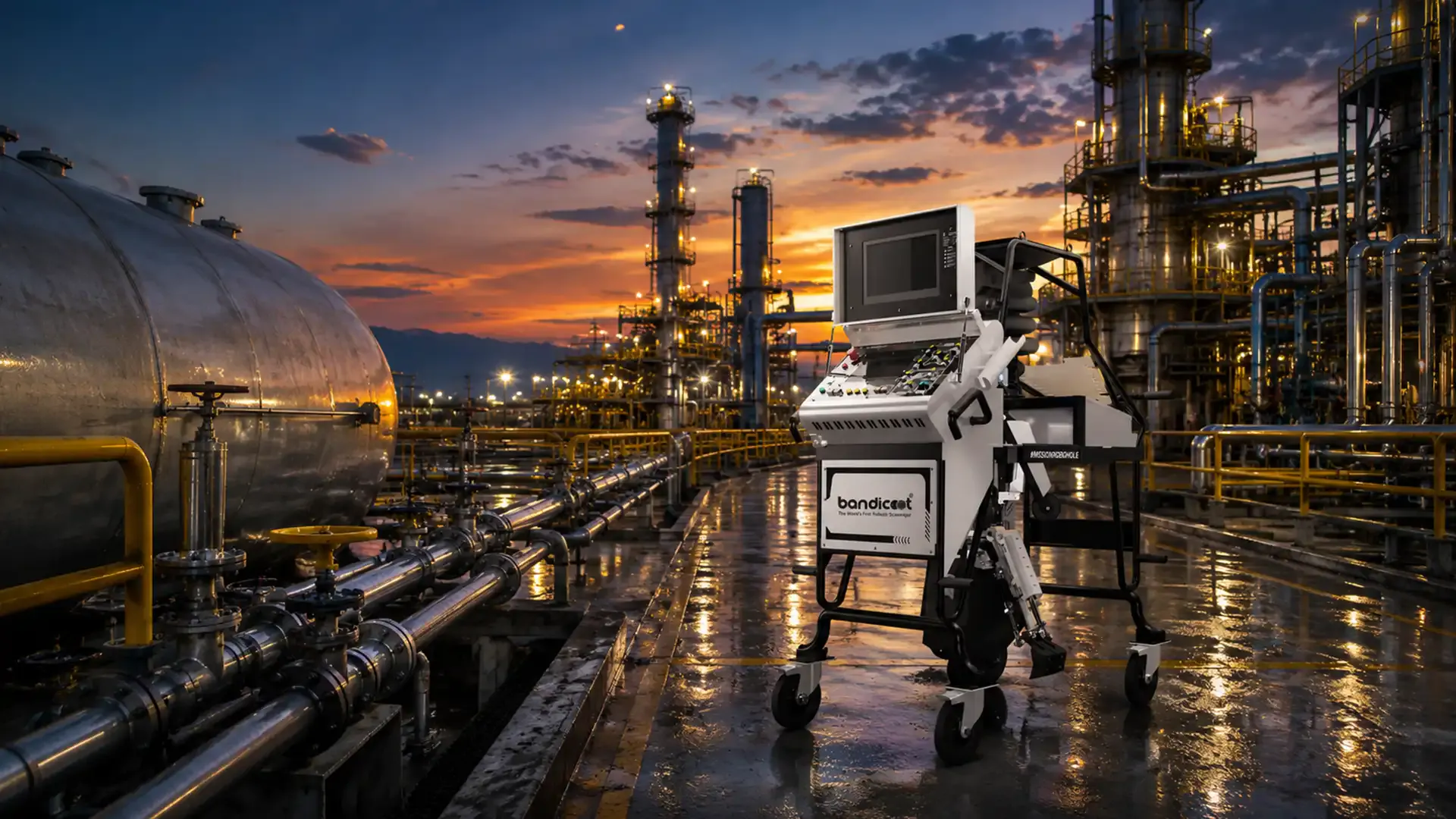
At first glance, a chemical plant appears to be a carefully orchestrated ecosystem of pipes, reactors, storage tanks, control rooms, and processing units. Every valve, pressure gauge, and monitoring system operates within a finely balanced industrial environment where precision is not simply desirable—it is essential. Yet behind this remarkable complexity lies an uncomfortable reality. Chemical manufacturing remains one of the world's most hazardous industrial sectors. High temperatures, toxic gases, corrosive substances, combustible materials, confined spaces, and continuous production processes create environments where even minor failures can have significant consequences. For the people responsible for maintaining these facilities, operational excellence has always carried an inherent element of risk. This is precisely why robotics is becoming increasingly important in chemical plants. Not merely because it introduces automation. But because it fundamentally changes the relationship between industrial productivity and human safety. The larger transformation underway is not about machines replacing people. It is about creating industrial systems where humans no longer need to stand in the path of preventable danger.
The Chemical Industry's Challenge: Efficiency Under Conditions of Risk
Chemical manufacturing occupies a unique position in the industrial economy.
The sector produces materials that support agriculture, pharmaceuticals, electronics, construction, energy, and consumer goods. Modern society depends on chemical plants in ways that often go unnoticed.
Yet the operational demands of these facilities are extraordinary.
Production systems frequently run continuously. Equipment must withstand harsh environments for extended periods. Maintenance activities often involve hazardous areas where exposure to toxic substances or high-pressure systems presents serious risks.
The implications extend far beyond operational efficiency.
Any disruption in chemical processing can affect supply chains, create environmental concerns, and compromise worker safety. Consequently, chemical plants have historically faced a difficult balancing act: maintaining productivity while minimizing risk.
This is where robotics is beginning to reshape industrial thinking.
Why Dangerous Environments Are Driving Robotic Adoption
Some industrial environments are simply not designed for sustained human presence.
Storage tanks containing hazardous substances require inspections. Pipelines carrying corrosive materials demand regular monitoring. High-temperature areas need periodic assessments. Leak detection activities may involve exposure to environments with uncertain atmospheric conditions.
Traditionally, these tasks often required personnel to enter hazardous zones under controlled procedures.
Today, that assumption is increasingly being challenged.
Inspection robots can navigate confined spaces and collect operational data without exposing workers to unnecessary risks. Remote-operated systems can assess equipment integrity, identify anomalies, and conduct inspections in areas where human access is difficult or dangerous.
Yet the real significance lies elsewhere.
Every time a robot enters a hazardous environment instead of a worker, industrial safety evolves from protective management toward risk elimination.
That distinction is profound.
Inspection Is Becoming Intelligent and Continuous
The future of chemical plant operations is increasingly being shaped by information.
Unexpected failures are expensive.
Unplanned shutdowns disrupt production.
Equipment degradation often progresses invisibly until operational consequences become severe.
Historically, maintenance depended largely on periodic inspections and scheduled shutdowns. While effective to a degree, these approaches frequently identify issues only after deterioration has already advanced.
Robotics is introducing a different model.
Mobile inspection robots equipped with sensors, imaging systems, thermal monitoring technologies, and autonomous navigation capabilities can gather data continuously. Critical assets can be observed more frequently and with greater consistency than traditional approaches often allow.
But the larger shift is strategic.
Chemical plants are gradually moving from reactive maintenance toward predictive operations.
The ability to identify problems before they escalate changes not only maintenance strategies but also the economics of industrial reliability itself.
Efficiency Is No Longer Limited to Production Output
Industrial efficiency has traditionally been measured through production metrics.
Higher throughput.
Reduced downtime.
Lower operational costs.
These indicators remain important.
However, modern industrial thinking increasingly recognizes a broader definition of efficiency.
A plant that minimizes accidents is more efficient.
A facility that avoids environmental incidents is more resilient.
An operation that prevents unplanned shutdowns protects both productivity and reputation.
Robotics contributes to all three dimensions simultaneously.
Inspection activities become more frequent. Maintenance decisions become increasingly data-driven. Hazardous interventions become less dependent on direct human exposure.
The implications extend far beyond automation.
Efficiency and safety are no longer competing priorities.
Increasingly, they reinforce one another.
The Human Role Is Being Redefined, Not Reduced
Whenever discussions around industrial robotics emerge, concerns about workforce displacement inevitably follow.
Yet chemical plants reveal a different reality.
Robotic systems are not replacing engineering judgment, operational expertise, or human decision-making.
They are changing where people create value.
Routine inspections become automated.
Hazardous interventions become remote.
Data collection becomes continuous.
Human expertise shifts toward analysis, planning, diagnostics, and strategic decision-making.
This is where the conversation becomes more important.
The future industrial workforce may spend less time entering dangerous environments and more time interpreting information, managing complex systems, and making higher-order decisions.
That transition represents not merely technological progress but occupational evolution.
The Rise of Autonomous Chemical Facilities
Global manufacturing is entering an era increasingly defined by Industry 4.0 principles.
Connectivity, artificial intelligence, sensor networks, and autonomous systems are gradually converging into integrated industrial ecosystems.
Chemical plants are emerging as important participants in this transformation.
Robotics serves as a critical bridge between physical infrastructure and intelligent operations. Inspection systems generate data. Digital platforms analyze conditions. Predictive models identify potential risks. Operators gain greater visibility into assets that were previously difficult to monitor continuously.
Some countries established industrial leadership through scale and manufacturing capacity.
The next generation of industrial leaders may distinguish themselves through intelligent infrastructure capable of operating with unprecedented levels of safety, resilience, and operational awareness.
Building Industrial Systems That Protect Human Potential
The most meaningful contribution of robotics in chemical plants may not be its technical sophistication.
It may be its philosophy.
For decades, industrial progress often required workers to adapt to hazardous environments.
Today, technology is increasingly adapting environments to protect workers.
That shift carries enormous significance.
Every avoided accident protects families and communities. Every prevented shutdown strengthens economic resilience. Every hazardous task performed remotely reflects a deeper commitment to human well-being. Chemical plants will always involve complexity. Certain risks will remain inherent to industrial operations.
But robotics is fundamentally changing how those risks are managed. Because the future of industry is not merely about producing more. It is about producing more intelligently.
And ultimately, the true measure of industrial advancement is not how efficiently machines operate.
It is how effectively technology safeguards the people whose knowledge, judgment, and expertise keep those systems running
Related Blogs

Hazardous-Environment Robotics: Where Physical AI Meets India's Sanitation and Refinery Safety Crisis
At the India AI Impact Summit 2026 in New Delhi, EY India demonstrated “Scout,” a companion robot combining digital twins, robotics, and physical AI to help refinery workers track hazardous pipeline alerts that overwhelm small monitoring teams. It's a compelling demo. But in India, this isn't a preview of the future — it's already a deployed industry, with a body count that makes the case for it.

India’s Robotics Revolution: Innovation Beyond Software
For much of the past two decades, India's innovation story has been synonymous with software. The country became a global technology powerhouse by building expertise in IT services, digital platforms, and enterprise software. That legacy remains a remarkable achievement, but a quieter transformation is now taking shape—one driven not by code alone, but by machines capable of interacting with the physical world. This shift marks the rise of next-generation robotics, where engineering, artificial intelligence, advanced electronics, and intelligent sensing converge to solve problems that software alone cannot address. As industries modernise and infrastructure grows more complex, India's next wave of innovation is increasingly being built in laboratories, manufacturing facilities, and robotics research centres.

Scaling Deep-Tech Innovation: From Research to Commercialisation
Brilliant engineering ideas rarely fail because they lack technical merit. More often, they struggle to cross the difficult bridge between laboratory success and large-scale deployment. Building a working prototype is an achievement. Transforming that prototype into a reliable product that industries trust, regulators approve, and customers adopt is an entirely different challenge. This transition is where every deep tech startup is tested. Unlike software ventures that can iterate rapidly with minimal physical constraints, deep-tech companies must navigate complex engineering, manufacturing, certification, funding, and market adoption simultaneously. As India strengthens its innovation ecosystem, the ability to commercialise advanced technologies may become just as important as inventing them.