
Measuring Robotics Impact by Dignity, Not Just Output
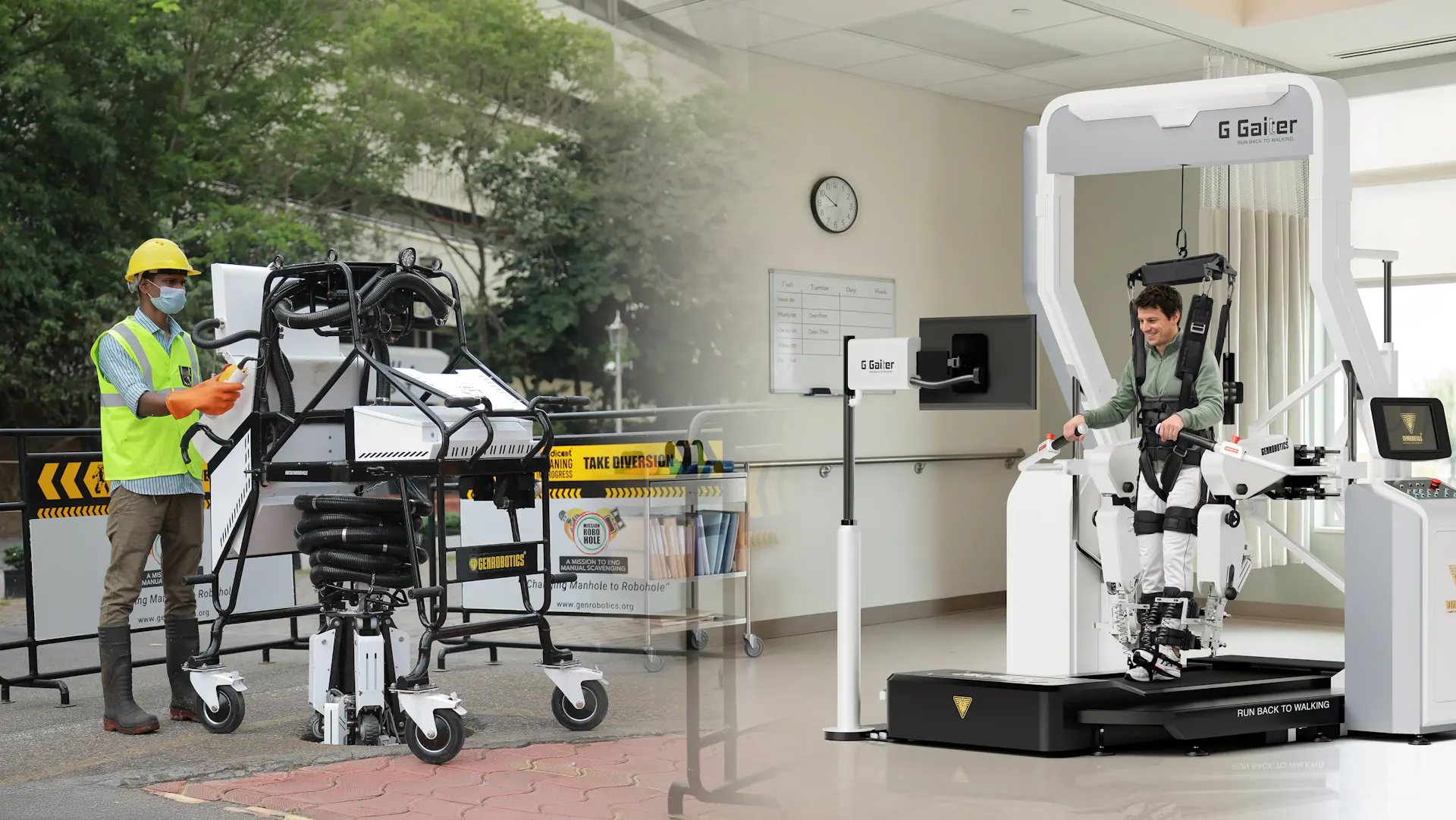
Robotics is usually measured by productivity, speed, precision and cost savings. But is output the only measure of progress? In many industries, the real value of robotics lies elsewhere: protecting workers from dangerous environments, creating safer jobs, supporting people with mobility challenges and widening access to essential services. This is robotics for social good, and more robotics companies in India are starting to build for it. Genrobotics is a purpose-led robotics company in India built on that idea. Through products such as Bandicoot, Wilboar and G-Gaiter, it tackles manual scavenging, hazardous confined-space cleaning and rehabilitation. The question it asks is not just how much work a robot completes, but how many lives it improves.
What does robotics for social good mean?
It means designing robots around human needs, not only commercial performance. A good robot solves a real problem, reduces avoidable harm and creates a better role for the people connected to the work. That could mean removing a worker from a sewer, helping a patient walk again, or inspecting an oil tank without exposing a technician.
Success then rests on five questions:
- Did it reduce exposure to danger?
- Did it give the worker more control over the task?
- Did it create safer, more skilled employment?
- Did it make a service more accessible?
- Did it protect a person's health, independence and dignity?
Why output alone is an incomplete measure
Output metrics such as waste removed, task time and downtime avoided still matter. But a robot can post high numbers while the human cost stays the same. If workers still face toxic gas, unsafe lifting or stigma, the job isn't done.
A dignity-centred approach adds human outcomes to the dashboard: hazardous entries eliminated, incidents avoided and workers retrained. In hazardous environment robotics, the most valuable result is often something that never happens. No worker enters a contaminated space, and no technician breathes toxic gas.
Genrobotics: technology built around people
Genrobotics started in sanitation and now works across medical and mobility, oil and gas, defence and aerospace, and robotics and AI research. The thread running through all of it: wherever people face dangerous or physically demanding work, engineering should step in.
Sanitation: safer work, not fewer workers
Sanitation workers have long been sent into confined spaces full of sludge and dangerous gases. Genrobotics products such as Bandicoot and Wilboar clean these spaces by remote operation, with Bandicoot handling vertical manholes and Wilboar handling large horizontal confined spaces,while the operator stays outside. The worker who once went in can now run the machine, watch its cameras and build a skilled career in robotic maintenance. A robot alone doesn't create dignity, though. That also takes training, fair pay and respect.
Healthcare: independence, one step at a time
Genrobotics' Medical & Mobility division builds G-Gaiter robotic gait trainers and upper-body rehabilitation systems. Therapy sessions can be counted, but the real impact is a patient standing with less help, or doing a daily task alone again.
High-risk industries: distance from danger
In oil and gas, Genrobotics' systems handle online tank cleaning, confined-space inspection and asset monitoring. In defence and aerospace, it is adapting its heavy-duty robotics for high-risk missions, with research focused on autonomous mobility and sensor fusion. Here, a robot's biggest benefit is the distance it puts between a person and the hazard.
How should robotics impact be measured?
As robot manufacturers in India, robotics engineering companies in India and AI robotics companies in India grow, they can measure success more completely with five questions:
- How much danger was reduced? Count hazardous entries avoided and exposure hours cut.
- What happened to the people involved? Track training, new operator and maintenance roles, and patient independence.
- Did safety improve in practice? Track accidents, near misses and real working conditions, not just a safe-looking machine.
- Who can now access the service? Robots should reach smaller cities, hospitals and communities, not only large organisations.
- Do people trust it? Trust comes from honesty about what the robot can do, proper training and support after installation.
What success looks like for Genrobotics
It isn't just robots manufactured or tasks completed. Success is a sanitation worker who never has to enter a hazardous space, an operator with a new technical skill, a patient taking a step towards independence and a technician who inspects dangerous equipment from a safe distance. These outcomes don't fit neatly on a productivity chart, but they're why the technology matters.
What does robotics for social good mean?
It means building and judging robots by how they improve people's lives, not only by how much they produce. In practice, that means robots that keep people out of dangerous spaces, move workers into safer roles or help patients regain independence.
How can the impact of robotics be measured?
Impact can be measured through productivity and reliability, but also through hazardous exposure avoided, safety incidents reduced, workers trained, people enabled and improvements in independence.
Why should dignity be part of robotics measurement?
Robots affect real people. A machine that prevents hazardous exposure, supports patient independence or creates a safer career path delivers value that cannot be understood through output figures alone.
What is the most important result of hazardous environment robotics?
The most important result may be the danger that is avoided. A robot can help prevent unnecessary exposure to toxic materials, confined spaces, unstable structures, heavy equipment or other high-risk conditions.
Can robotics improve the quality of public services?
Yes. Robotics can help public agencies maintain sanitation infrastructure, inspect difficult locations and deliver essential services more safely. The benefits are strongest when the technology is supported by trained teams, clear procedures and regular maintenance.
Related Blogs

Hazardous-Environment Robotics: Where Physical AI Meets India's Sanitation and Refinery Safety Crisis
At the India AI Impact Summit 2026 in New Delhi, EY India demonstrated “Scout,” a companion robot combining digital twins, robotics, and physical AI to help refinery workers track hazardous pipeline alerts that overwhelm small monitoring teams. It's a compelling demo. But in India, this isn't a preview of the future — it's already a deployed industry, with a body count that makes the case for it.

India’s Robotics Revolution: Innovation Beyond Software
For much of the past two decades, India's innovation story has been synonymous with software. The country became a global technology powerhouse by building expertise in IT services, digital platforms, and enterprise software. That legacy remains a remarkable achievement, but a quieter transformation is now taking shape—one driven not by code alone, but by machines capable of interacting with the physical world. This shift marks the rise of next-generation robotics, where engineering, artificial intelligence, advanced electronics, and intelligent sensing converge to solve problems that software alone cannot address. As industries modernise and infrastructure grows more complex, India's next wave of innovation is increasingly being built in laboratories, manufacturing facilities, and robotics research centres.

Scaling Deep-Tech Innovation: From Research to Commercialisation
Brilliant engineering ideas rarely fail because they lack technical merit. More often, they struggle to cross the difficult bridge between laboratory success and large-scale deployment. Building a working prototype is an achievement. Transforming that prototype into a reliable product that industries trust, regulators approve, and customers adopt is an entirely different challenge. This transition is where every deep tech startup is tested. Unlike software ventures that can iterate rapidly with minimal physical constraints, deep-tech companies must navigate complex engineering, manufacturing, certification, funding, and market adoption simultaneously. As India strengthens its innovation ecosystem, the ability to commercialise advanced technologies may become just as important as inventing them.