
How Intelligent Automation Is Transforming Indian Industries
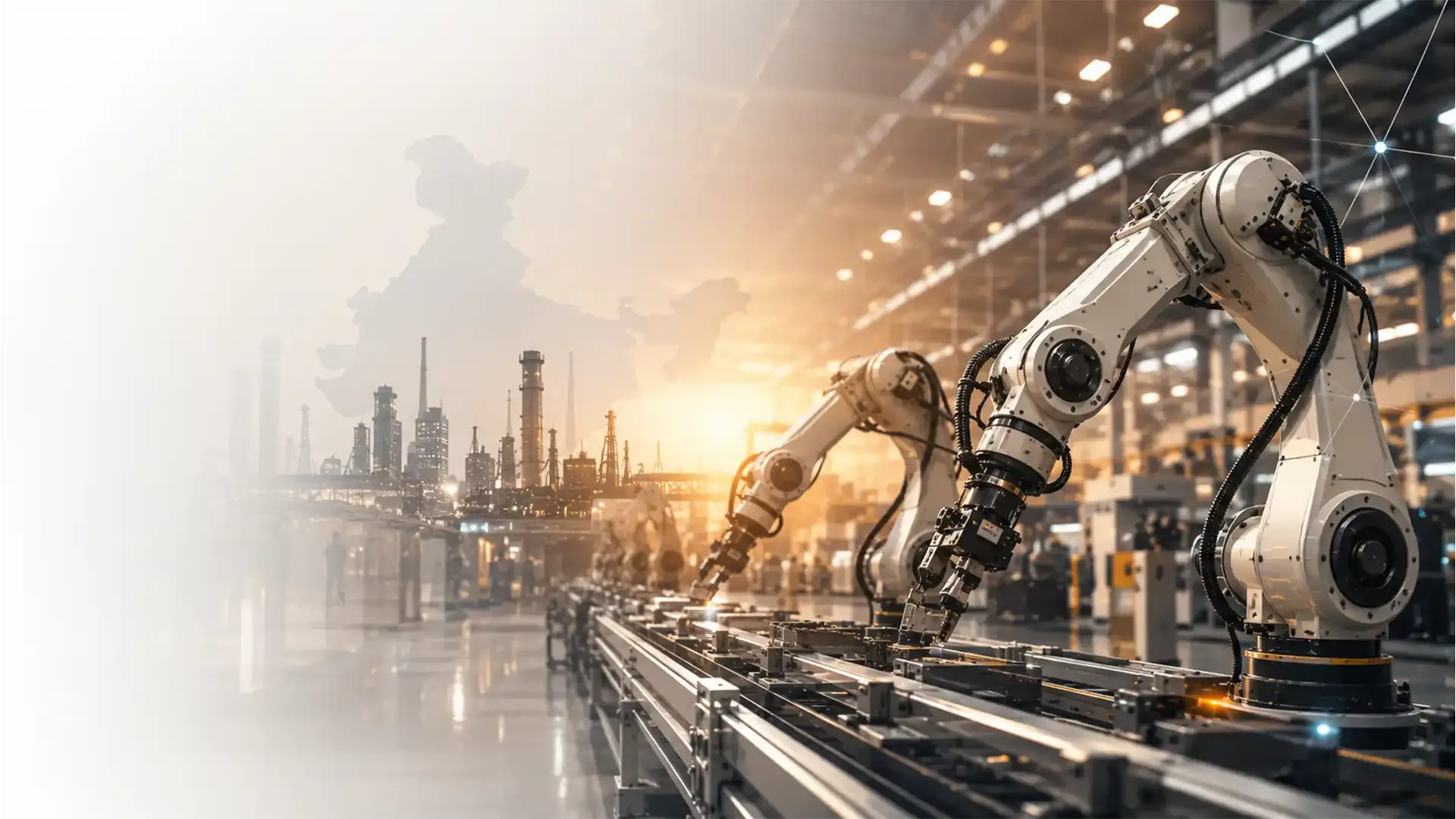
Walk through any modern industrial facility today and one trend becomes immediately apparent. Machines are no longer working in isolation. Inspection systems communicate with analytics platforms, sensors continuously monitor equipment health, and robotic systems are increasingly making decisions based on real-time operational data rather than fixed instructions. This shift marks the arrival of intelligent automation—a new phase of industrial transformation where automation is no longer measured by how many tasks are mechanised, but by how effectively technology helps organisations make better decisions. For every robotics startup India is nurturing today, this transition represents an opportunity to solve some of the country's most complex industrial challenges through engineering, artificial intelligence, and robotics working together.
Automation Is Becoming Smarter, Not Just Faster
Industrial automation has traditionally focused on improving speed, consistency, and efficiency.
Assembly lines became more productive.
Production became more predictable.
Human error declined.
Intelligent automation builds upon these achievements by introducing perception, learning, and adaptive decision-making into industrial operations.
Instead of following rigid programming alone, intelligent systems analyse sensor inputs, interpret visual information, recognise operational anomalies, and recommend actions based on continuously evolving data.
This capability is reshaping how industries approach productivity, maintenance, safety, and infrastructure management.
For a modern robotics startup India ecosystem, intelligence is rapidly becoming the defining differentiator.
Why Indian Industries Are Accelerating Adoption
Several factors are driving this transition simultaneously.
Manufacturers face increasing global competition.
Infrastructure operators manage ageing assets with constrained budgets.
Utilities must improve service reliability while meeting stricter regulatory standards.
Industrial organisations also face growing expectations around sustainability, workplace safety, and operational transparency.
Traditional approaches alone cannot meet all of these demands.
Intelligent automation enables organisations to improve performance without relying solely on workforce expansion or additional physical infrastructure.
Technology becomes a multiplier for engineering capability rather than simply a replacement for manual processes.
Beyond Manufacturing: Intelligent Automation Is Expanding Everywhere
The perception that robotics belongs only inside automotive factories is rapidly disappearing.
Today, intelligent robotic systems support operations across sectors including:
- Oil and gas
- Mining
- Utilities
- Water and wastewater
- Public infrastructure
- Logistics
- Warehousing
- Renewable energy
These industries often involve environments where inspections are hazardous, access is restricted, or infrastructure assets span vast geographic areas.
Intelligent automation allows organisations to monitor operations remotely while collecting detailed information about equipment condition and infrastructure performance.
This broader adoption is creating significant opportunities for every robotics startup India focused on solving industry-specific operational challenges.
Data Has Become an Operational Resource
Every industrial system generates information.
Sensors monitor equipment performance.
Inspection robots capture thousands of images.
Control systems record operational events.
Maintenance teams document repairs and inspections.
Historically, much of this information remained isolated within different departments.
Intelligent automation changes that dynamic.
By integrating robotics with artificial intelligence, machine vision, and analytics platforms, organisations can transform raw operational data into actionable insights.
Patterns become visible.
Emerging failures become detectable.
Maintenance becomes predictive rather than reactive.
The value no longer lies in collecting more data.
It lies in understanding what the data reveals.
Safety Is Becoming an Engineering Outcome
One of the strongest drivers behind intelligent automation is the pursuit of safer industrial operations.
Many sectors continue to involve confined spaces, hazardous environments, elevated structures, or complex industrial assets where direct human access carries significant risk.
Rather than sending personnel into potentially dangerous conditions, robotic inspection systems can perform preliminary assessments, identify hazards, and gather operational information remotely.
Engineering teams receive better information before intervention begins.
Operational planning improves.
Worker exposure decreases.
This philosophy reflects a broader evolution within industrial engineering—designing systems that remove unnecessary risk through technology rather than relying solely on procedural controls.
India's Innovation Ecosystem Is Maturing
India's engineering landscape has evolved significantly over the past decade.
Earlier generations of industrial automation often depended heavily on imported technologies designed for different operational environments.
Today, indigenous innovation is producing solutions tailored specifically for Indian industries and infrastructure.
A successful robotics startup India increasingly combines expertise across robotics, embedded systems, artificial intelligence, computer vision, electronics, cloud computing, and industrial engineering.
This multidisciplinary approach enables companies to solve highly specialised challenges while remaining globally competitive.
Innovation is no longer measured simply by technical sophistication.
Its value is determined by measurable operational impact.
From Technology Adoption to Organisational Transformation
Implementing intelligent automation requires more than purchasing advanced equipment.
Organisations must also invest in digital infrastructure, workforce development, cybersecurity, asset management systems, and process redesign.
Technology performs best when integrated into existing engineering workflows rather than introduced as a standalone solution.
This shift often changes organisational culture as much as operational capability.
Engineering teams increasingly rely on continuous data instead of periodic inspections.
Maintenance becomes condition-based.
Operational decisions become evidence-driven.
The transformation extends well beyond automation itself.
Engineering Solutions with Real-World Impact
India's growing robotics sector demonstrates how engineering innovation can address challenges that extend beyond manufacturing productivity.
Companies such as Genrobotics illustrate this evolution by developing intelligent robotic systems for hazardous infrastructure environments. Their work highlights how a robotics startup India can apply robotics, artificial intelligence, and advanced engineering to improve worker safety, infrastructure inspection, and operational efficiency in sectors where traditional methods face significant limitations.
The broader significance lies in showing how intelligent automation can create measurable public and industrial value simultaneously.
The Future Belongs to Industries That Continuously Learn
Industrial competitiveness is increasingly determined by an organisation's ability to adapt.
Markets evolve.
Infrastructure ages.
Environmental conditions change.
Operational risks emerge unexpectedly.
Intelligent automation provides organisations with the ability to observe these changes continuously, interpret them intelligently, and respond proactively rather than reactively.
For every robotics startup India is producing today, the challenge is no longer limited to building better machines. It is about creating systems that combine engineering precision with digital intelligence to solve meaningful industrial problems.
The next decade of Indian industry will likely be defined not by how many processes become automated, but by how effectively organisations use intelligent technologies to improve safety, strengthen resilience, and make better decisions every single day. Those capabilities will shape a more competitive industrial ecosystem—one where innovation is measured not only by what technology can do, but by the lasting value it creates for industries, infrastructure, and society.
Related Blogs

Hazardous-Environment Robotics: Where Physical AI Meets India's Sanitation and Refinery Safety Crisis
At the India AI Impact Summit 2026 in New Delhi, EY India demonstrated “Scout,” a companion robot combining digital twins, robotics, and physical AI to help refinery workers track hazardous pipeline alerts that overwhelm small monitoring teams. It's a compelling demo. But in India, this isn't a preview of the future — it's already a deployed industry, with a body count that makes the case for it.

India’s Robotics Revolution: Innovation Beyond Software
For much of the past two decades, India's innovation story has been synonymous with software. The country became a global technology powerhouse by building expertise in IT services, digital platforms, and enterprise software. That legacy remains a remarkable achievement, but a quieter transformation is now taking shape—one driven not by code alone, but by machines capable of interacting with the physical world. This shift marks the rise of next-generation robotics, where engineering, artificial intelligence, advanced electronics, and intelligent sensing converge to solve problems that software alone cannot address. As industries modernise and infrastructure grows more complex, India's next wave of innovation is increasingly being built in laboratories, manufacturing facilities, and robotics research centres.

Scaling Deep-Tech Innovation: From Research to Commercialisation
Brilliant engineering ideas rarely fail because they lack technical merit. More often, they struggle to cross the difficult bridge between laboratory success and large-scale deployment. Building a working prototype is an achievement. Transforming that prototype into a reliable product that industries trust, regulators approve, and customers adopt is an entirely different challenge. This transition is where every deep tech startup is tested. Unlike software ventures that can iterate rapidly with minimal physical constraints, deep-tech companies must navigate complex engineering, manufacturing, certification, funding, and market adoption simultaneously. As India strengthens its innovation ecosystem, the ability to commercialise advanced technologies may become just as important as inventing them.