
Industry 4.0 and the Rise of Autonomous Robots Explained
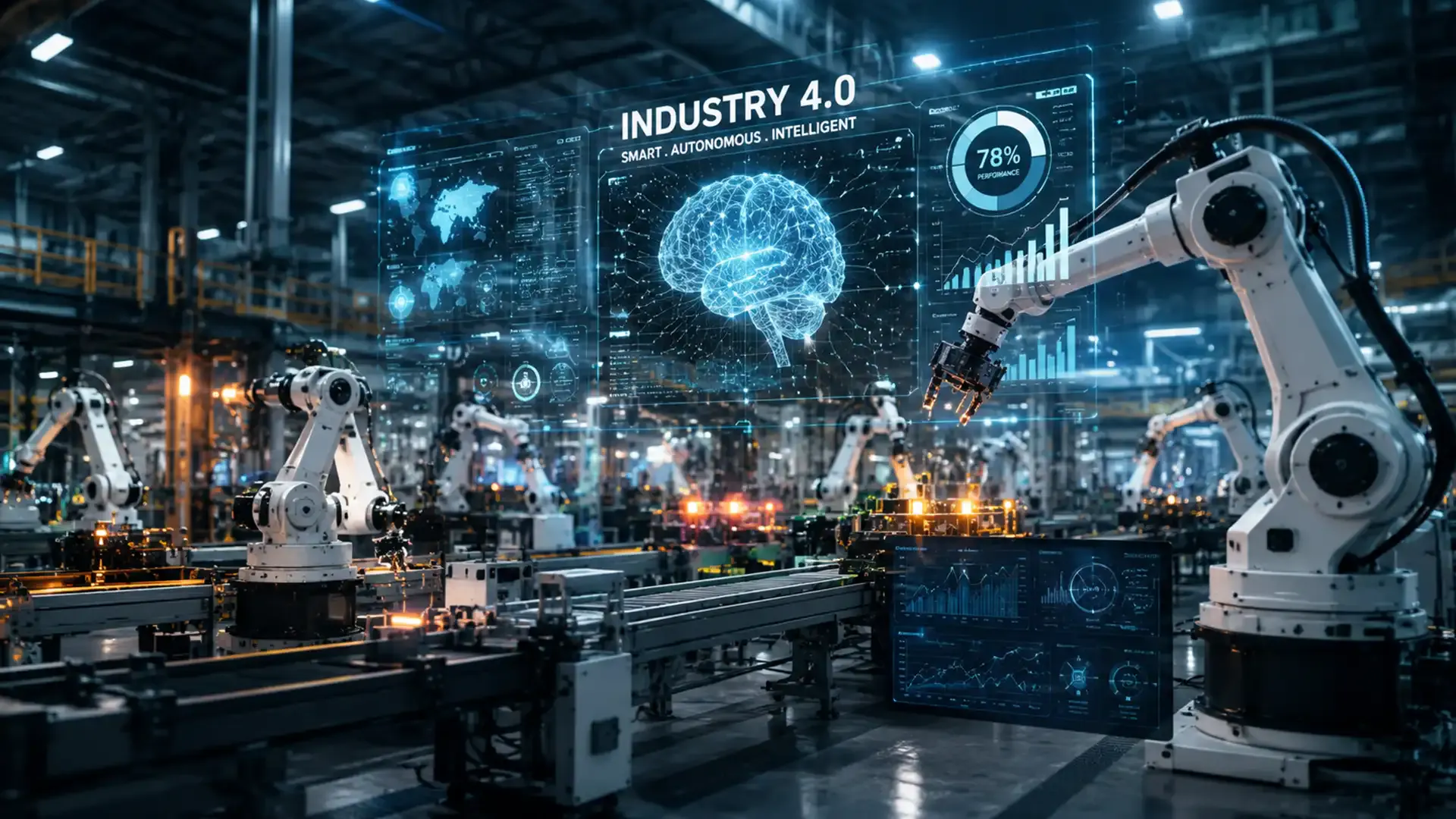
A factory floor once operated like a perfectly choreographed assembly line. Machines performed isolated tasks. Human operators supervised processes. Data was collected periodically. Decisions were made after problems occurred. Production systems functioned efficiently, but largely in silos. That model is rapidly becoming history. A new industrial era is emerging—one in which machines communicate continuously, systems learn from data, and robots no longer simply execute instructions but increasingly make intelligent decisions within defined environments. This transformation is widely known as Industry 4.0. Yet reducing Industry 4.0 to automation or digital transformation misses its deeper significance. At its core, Industry 4.0 represents a fundamental shift in how industries perceive, understand, and manage complexity. And perhaps no technology embodies this shift more powerfully than autonomous robots. Because the rise of autonomous robotics is not merely changing manufacturing processes. It is redefining the very relationship between humans, machines, and industrial intelligence.
Every Industrial Revolution Changed Human Capability
The first industrial revolution mechanized physical labor through steam power.
The second introduced mass production and electrification.
The third brought computing and automation into industrial environments.
Each transition expanded what human societies could build and produce.
Industry 4.0 represents something different.
For the first time, industrial systems are being designed to sense, analyze, learn, and respond dynamically to changing conditions.
The implications extend far beyond factories.
Production facilities, warehouses, healthcare systems, logistics networks, utilities, and urban infrastructure are increasingly becoming interconnected ecosystems capable of generating and acting upon vast amounts of information.
This is where autonomous robots enter the picture.
They are becoming the physical agents of Industry 4.0—machines capable of translating digital intelligence into real-world action.
From Automated Machines to Autonomous Decision-Making
Traditional industrial robots excelled at repetition.
They performed predefined tasks with extraordinary speed and precision but remained dependent on structured environments and explicit instructions.
Autonomous robots operate differently.
Equipped with sensors, machine vision, artificial intelligence, advanced computing, and real-time communication capabilities, these systems can perceive surroundings, interpret information, and adapt their actions accordingly.
An autonomous mobile robot can reroute itself around obstacles inside a warehouse. Inspection robots can identify anomalies and determine areas requiring closer examination. Manufacturing systems can dynamically adjust operations based on changing production conditions.
Yet the real significance lies elsewhere.
The industrial world is witnessing the emergence of machines that are increasingly context aware.
That capability changes everything.
Because once machines gain the ability to understand conditions rather than simply follow instructions, entirely new operational possibilities emerge.
The Rise of Intelligent Factories
Modern factories are becoming increasingly interconnected environments.
Production lines communicate with maintenance systems. Sensors continuously monitor equipment performance. Data platforms analyze operational conditions in real time. Supply chains increasingly function as integrated networks rather than isolated processes.
Autonomous robots are accelerating this transition.
In manufacturing environments, they transport materials, inspect production assets, monitor equipment conditions, and support predictive maintenance initiatives. Their ability to operate continuously and respond dynamically reduces inefficiencies while improving operational resilience.
But the larger shift is philosophical.
Factories are gradually evolving from places where humans manage machines into environments where intelligent systems collaborate with people to optimize outcomes.
The factory itself is becoming increasingly aware of its own condition.
And awareness is becoming one of industry's most valuable assets.
Why Autonomy Matters Beyond Productivity
Industrial discussions often emphasize efficiency gains, production output, and cost reductions.
These benefits are undoubtedly important.
Yet autonomous robotics carries implications that extend much further.
Many industrial activities involve hazardous environments, repetitive tasks, and operations requiring constant monitoring. Inspection of confined spaces, exposure to dangerous environments, and physically demanding processes have historically depended heavily on human intervention.
Autonomous robots increasingly assume these responsibilities.
This shift is not fundamentally about replacing people.
It is about redesigning human participation in industry.
Engineers become system architects rather than manual operators. Technicians evolve into supervisors of intelligent systems. Workers increasingly focus on judgment, strategy, and problem-solving while machines undertake tasks involving repetition, hazardous exposure, or continuous monitoring.
This is where the conversation becomes more important.
Industry 4.0 is not solely an automation story.
It is also a workforce transformation story.
The Boundaries Between Industries Are Beginning to Blur
The influence of autonomous robotics is extending beyond manufacturing.
In logistics, autonomous systems navigate warehouses and optimize inventory movement. In healthcare, robotic rehabilitation systems support recovery journeys through intelligent, adaptive interventions. Inspection robots are monitoring pipelines, energy infrastructure, and industrial facilities with unprecedented consistency.
Public infrastructure is experiencing similar transformation.
Water systems, sanitation networks, transportation assets, and utilities increasingly require continuous monitoring and predictive management capabilities.
Some of the most meaningful applications of autonomous robotics are emerging precisely in environments where human exposure to risk is difficult to justify. Technologies capable of inspecting hazardous industrial assets or maintaining critical infrastructure remotely are demonstrating that autonomy can deliver both operational and social value.
The implications extend far beyond productivity metrics.
Autonomous robotics is becoming an enabler of resilience, safety, and more inclusive infrastructure systems.
The Global Race Is About More Than Technology Leadership
Governments worldwide are investing heavily in Industry 4.0 initiatives.
Germany advanced the concept through its manufacturing modernization strategy. Japan strengthened industrial competitiveness through precision engineering and robotics leadership. Several countries are rapidly integrating artificial intelligence and autonomous systems into their national industrial policies.
Yet emerging economies possess an opportunity to define Industry 4.0 differently.
They can leverage autonomous robotics not only to improve industrial productivity but also to solve deeply human challenges involving worker safety, healthcare access, environmental management, and public infrastructure resilience.
This distinction matters.
Japan built robotics leadership through industrial precision.
The next generation of leadership may emerge through public-impact innovation that uses autonomy to improve quality of life while modernizing economies.
The Future Will Belong to Systems That Can Sense, Learn, and Adapt
History often remembers transformative technologies not because they automated tasks but because they fundamentally changed what societies considered possible.
Electricity changed production.
The internet changed communication.
Artificial intelligence is changing decision-making.
Autonomous robotics may ultimately change how industries think.
Because autonomous robots are not simply machines performing work.
They are becoming participants within intelligent ecosystems—systems capable of sensing environments, learning from data, and adapting to complexity in real time.
Industry 4.0 is, therefore, far more than a technological upgrade.
It is the emergence of industrial environments that increasingly behave like living systems—observing, learning, and continuously improving.
The factories, infrastructure networks, and public systems of the future will not merely operate more efficiently.
They will understand themselves more deeply.
And within that transformation lies perhaps the most profound implication of all.
The rise of autonomous robots is not teaching machines to become more human.
It is enabling human societies to build industries that are safer, more resilient, and infinitely more intelligent than anything that came before.
Related Blogs

Hazardous-Environment Robotics: Where Physical AI Meets India's Sanitation and Refinery Safety Crisis
At the India AI Impact Summit 2026 in New Delhi, EY India demonstrated “Scout,” a companion robot combining digital twins, robotics, and physical AI to help refinery workers track hazardous pipeline alerts that overwhelm small monitoring teams. It's a compelling demo. But in India, this isn't a preview of the future — it's already a deployed industry, with a body count that makes the case for it.

India’s Robotics Revolution: Innovation Beyond Software
For much of the past two decades, India's innovation story has been synonymous with software. The country became a global technology powerhouse by building expertise in IT services, digital platforms, and enterprise software. That legacy remains a remarkable achievement, but a quieter transformation is now taking shape—one driven not by code alone, but by machines capable of interacting with the physical world. This shift marks the rise of next-generation robotics, where engineering, artificial intelligence, advanced electronics, and intelligent sensing converge to solve problems that software alone cannot address. As industries modernise and infrastructure grows more complex, India's next wave of innovation is increasingly being built in laboratories, manufacturing facilities, and robotics research centres.

Scaling Deep-Tech Innovation: From Research to Commercialisation
Brilliant engineering ideas rarely fail because they lack technical merit. More often, they struggle to cross the difficult bridge between laboratory success and large-scale deployment. Building a working prototype is an achievement. Transforming that prototype into a reliable product that industries trust, regulators approve, and customers adopt is an entirely different challenge. This transition is where every deep tech startup is tested. Unlike software ventures that can iterate rapidly with minimal physical constraints, deep-tech companies must navigate complex engineering, manufacturing, certification, funding, and market adoption simultaneously. As India strengthens its innovation ecosystem, the ability to commercialise advanced technologies may become just as important as inventing them.