
Human Centric Robotics and Inclusive Development
For years, the global robotics conversation revolved around speed, industrial automation, and manufacturing competitiveness. Nations competed over precision engineering. Corporations pursued efficiency gains. Investors searched relentlessly for the next breakthrough in artificial intelligence driven automation. But a more profound transformation is quietly unfolding beneath this highly technical narrative. The defining robotics question of the coming decade may not be how intelligent machines become. It may be whether technological progress can become genuinely human centered. That distinction matters far more than it initially appears. Across large parts of the world, development challenges are no longer limited to economic growth alone. Societies are confronting deeper questions around dignity, accessibility, healthcare equity, public safety, labour transformation, and infrastructure resilience. This is precisely where human centric robotics begins to matter. Not because it promises a futuristic technological utopia, but because it fundamentally reframes the purpose of innovation itself. And perhaps for the first time, robotics is moving beyond industrial ambition into something much larger: public impact infrastructure.
Why Human Centric Robotics Is Redefining the Purpose of Automation
Traditional automation models were built around one dominant objective: optimizing productivity.
Factories pursued faster output. Logistics systems aimed for operational efficiency. Machines were designed primarily to reduce manual intervention and maximize economic performance.
Human centric robotics introduces an entirely different philosophy.
Instead of asking, “How can humans adapt to machines?” the more important question becomes, “How can intelligent systems adapt to human realities?”
That shift changes the entire conversation.
A rehabilitation robot assisting stroke recovery is not merely improving operational efficiency inside hospitals. It is helping individuals regain movement, independence, and dignity after life altering neurological trauma.
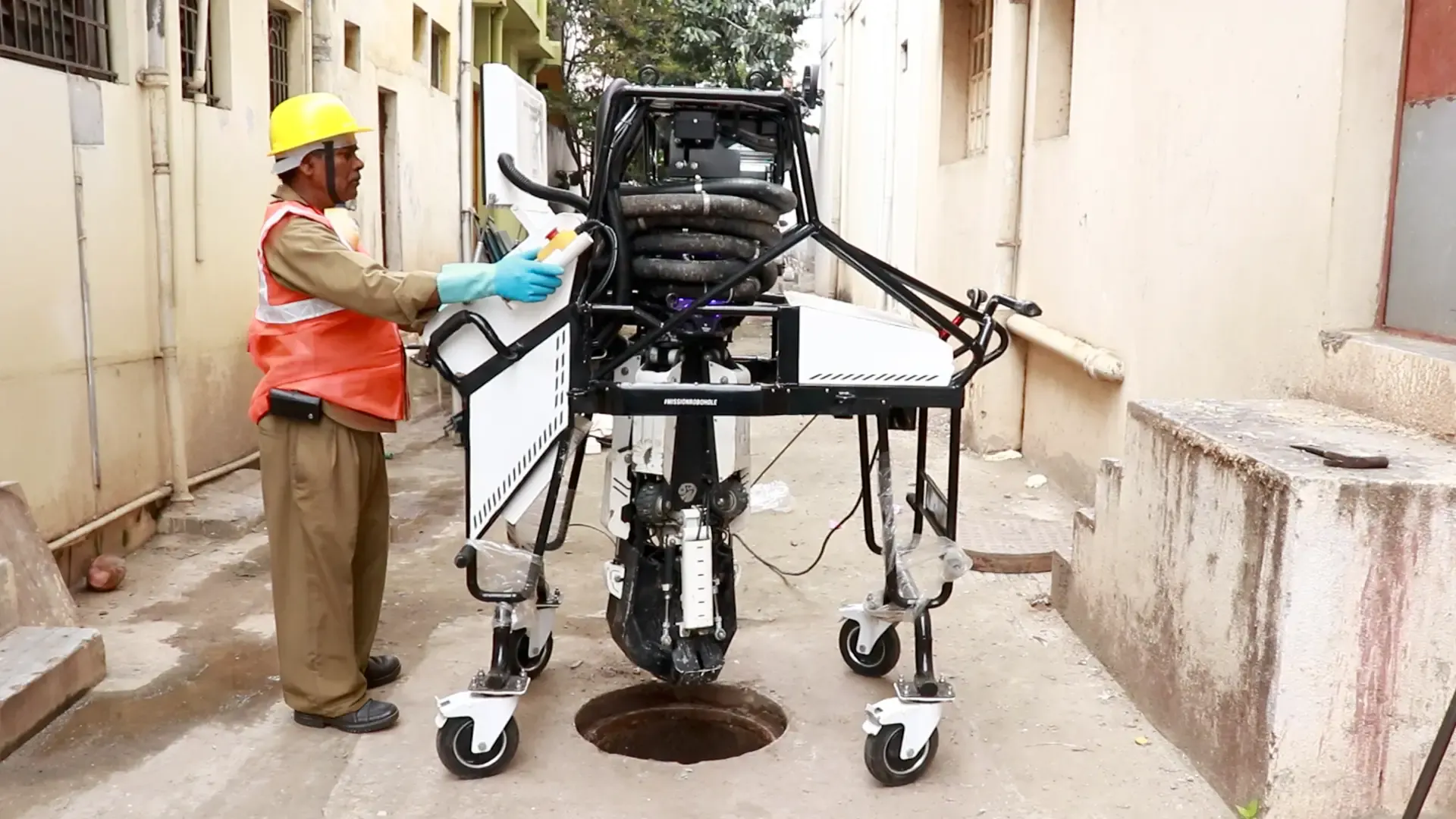
A robotic sewer cleaning system is not simply mechanizing sanitation work. It is removing human beings from environments that should never have depended on dangerous manual labour in the first place.
The implications extend far beyond engineering.
Human centric robotics forces societies to reconsider what development should ultimately achieve.
Internal Link Opportunity: Rehabilitation Robotics Solutions
Internal Link Opportunity: Robotic Sewer Cleaning Systems
Beyond Digital India: The Rise of Physical Public Technology
Over the last decade, digital transformation reshaped governance, finance, and communication across emerging economies. Digital payments, telemedicine, AI powered services, and online governance systems fundamentally altered how public services operate.
But the larger shift is now moving beyond screens and software into physical systems.
Cities still require sanitation workers. Patients still need rehabilitation support. Infrastructure systems still demand physical maintenance. Public safety still depends on real world operational environments.
This is where robotics becomes uniquely important.
Unlike purely digital technologies, robotics directly interacts with human realities. It operates where labour, mobility, safety, healthcare, and public infrastructure intersect.
That intersection makes human centric robotics deeply relevant for inclusive development.
Because inclusion is not only about internet access or digital participation.
It is about whether technological progress meaningfully improves lived human conditions.
And this is where public awareness becomes critical.
If societies continue treating robotics merely as an elite industrial technology, its most transformative social potential may remain underutilized. The real opportunity lies in making intelligent systems part of everyday public infrastructure.
Healthcare May Become the Strongest Human Story in Robotics
Nowhere is this transformation more visible than in rehabilitation and assistive healthcare.
Healthcare systems across many countries are already struggling with rising neurological disorders, aging populations, stroke recovery burdens, and long term mobility challenges. The shortage of rehabilitation specialists continues widening while patient demand increases dramatically.
Yet the real significance lies elsewhere.
Recovery itself is deeply human.
Rehabilitation is not merely clinical treatment. It often determines whether an individual regains confidence, independence, employability, and social participation.
Human centric robotics is beginning to reshape this space thoughtfully.
Robotic rehabilitation systems can support repetitive movement therapy with measurable precision while allowing therapists to focus more deeply on personalized patient engagement. Intelligent assistive technologies can also expand rehabilitation access into regions where specialist healthcare infrastructure remains limited.
Importantly, the objective is not replacing human care.
It is scaling human possibility.
That distinction may ultimately define the ethical future of medical robotics.
Internal Link Opportunity: Neuro Rehabilitation Technologies
Internal Link Opportunity: Assistive Medical Robotics
Sanitation Robotics Reveals the Moral Dimension of Innovation
If healthcare reveals the compassionate side of robotics, sanitation exposes its moral urgency.
Few sectors reveal structural inequality as starkly as hazardous sanitation labour. Across many developing economies, workers continue entering toxic sewer systems despite legal bans, policy interventions, and decades of public debate.
The persistence of this reality reflects something deeper than technological failure.
It reflects unequal risk embedded within public systems.
This is where the conversation becomes more important than robotics itself.
A robotic sanitation system entering a confined sewer space instead of a human being represents far more than mechanization. It represents a societal decision that certain forms of human suffering should no longer remain acceptable.
That is why sanitation robotics carries extraordinary symbolic significance.
It transforms robotics from luxury innovation into dignity centered infrastructure.
And perhaps for the first time, infrastructure modernization begins aligning directly with social justice.
This is not merely a municipal technology conversation anymore.
It is a public health conversation. A labour rights conversation. A governance conversation.
And increasingly, it is becoming a national development conversation.
Emerging Economies Could Build a Different Robotics Future
Historically, global robotics leadership emerged through manufacturing ecosystems. Japan refined industrial precision. Germany optimized engineering excellence. South Korea integrated robotics deeply into production systems.
Emerging economies may follow an entirely different trajectory.
Their robotics leadership may emerge through public impact deployment.
Countries confronting healthcare gaps, sanitation challenges, labour intensive infrastructure, and urban pressure possess a unique incentive to build robotics systems focused on affordability, accessibility, and social deployment at scale.
That creates a fascinating global contrast.
Advanced economies built robotics to maximize industrial productivity.
Emerging economies may build robotics to solve public infrastructure inequality.
This distinction could reshape the next phase of global deep technology leadership.
Technology Alone Cannot Build Inclusion
Despite its enormous promise, human centric robotics cannot succeed in isolation.
Inclusive innovation depends on ecosystems, not inventions alone.
Several structural questions remain critical:
- Who can access these technologies?
- Will deployment remain limited to elite institutions?
- Can governments scale robotics infrastructure effectively?
- Will workers displaced by automation receive meaningful reskilling opportunities?
- Can public systems build ethical and accountable deployment frameworks?
Without careful governance, even well intentioned technologies can deepen inequality instead of reducing it.
This is why policy alignment, public investment, institutional readiness, and workforce transformation will matter just as much as engineering capability.
The future of robotics is ultimately a governance challenge as much as a technological one.
The Most Important Robotics Revolution May Be Philosophical
Perhaps the deepest transformation underway is philosophical rather than technical.
Human centric robotics is gradually redefining how societies measure progress itself.
Success is no longer only about speed, output, or computational sophistication. Increasingly, societies are beginning to ask more meaningful questions.
Did innovation improve dignity?
Did it expand healthcare access?
Did it make dangerous work safer?
Did it strengthen public systems?
Did it improve quality of life meaningfully?
Those questions are beginning to shape the future direction of robotics globally.
And perhaps that is the most important transition of all.
Because the future of intelligent systems will not be remembered only for what machines became capable of doing.
It will be remembered for whether societies chose to use those capabilities to build a more humane, inclusive, and dignified version of development itself.
Related Blogs

Hazardous-Environment Robotics: Where Physical AI Meets India's Sanitation and Refinery Safety Crisis
At the India AI Impact Summit 2026 in New Delhi, EY India demonstrated “Scout,” a companion robot combining digital twins, robotics, and physical AI to help refinery workers track hazardous pipeline alerts that overwhelm small monitoring teams. It's a compelling demo. But in India, this isn't a preview of the future — it's already a deployed industry, with a body count that makes the case for it.

India’s Robotics Revolution: Innovation Beyond Software
For much of the past two decades, India's innovation story has been synonymous with software. The country became a global technology powerhouse by building expertise in IT services, digital platforms, and enterprise software. That legacy remains a remarkable achievement, but a quieter transformation is now taking shape—one driven not by code alone, but by machines capable of interacting with the physical world. This shift marks the rise of next-generation robotics, where engineering, artificial intelligence, advanced electronics, and intelligent sensing converge to solve problems that software alone cannot address. As industries modernise and infrastructure grows more complex, India's next wave of innovation is increasingly being built in laboratories, manufacturing facilities, and robotics research centres.

Scaling Deep-Tech Innovation: From Research to Commercialisation
Brilliant engineering ideas rarely fail because they lack technical merit. More often, they struggle to cross the difficult bridge between laboratory success and large-scale deployment. Building a working prototype is an achievement. Transforming that prototype into a reliable product that industries trust, regulators approve, and customers adopt is an entirely different challenge. This transition is where every deep tech startup is tested. Unlike software ventures that can iterate rapidly with minimal physical constraints, deep-tech companies must navigate complex engineering, manufacturing, certification, funding, and market adoption simultaneously. As India strengthens its innovation ecosystem, the ability to commercialise advanced technologies may become just as important as inventing them.