
Digital Twins and Industrial Robotics Explained Simply
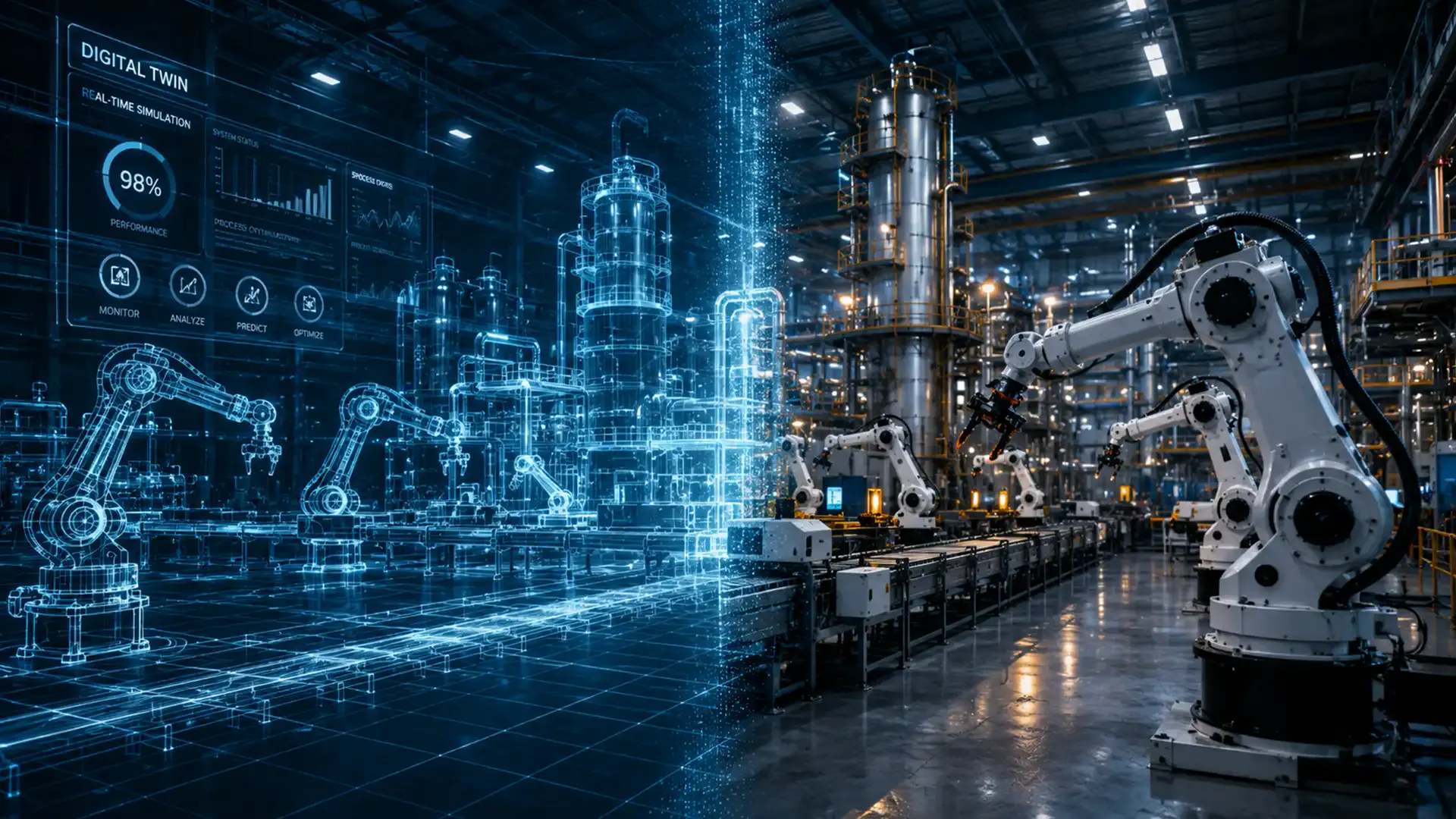
Imagine a manufacturing plant where engineers know a machine is likely to fail next week. Not because it has already broken down. Not because an operator noticed unusual vibrations. But because an exact digital replica of the machine has already experienced the failure. This is not science fiction. It is increasingly becoming industrial reality. Across factories, refineries, utility networks, and infrastructure systems, organizations are creating virtual representations of physical assets that continuously receive operational data, simulate conditions, and predict outcomes before they happen in the real world. These virtual replicas are known as digital twins. At the same time, industrial robotics is transforming how physical tasks are executed—performing inspections, handling materials, monitoring equipment, and operating in environments that are hazardous, repetitive, or inaccessible to humans. Individually, both technologies are powerful. Together, they are redefining what industrial intelligence looks like. Because the future of automation may no longer depend solely on machines that can act. It may depend on machines that can anticipate.
Understanding the Digital Twin: A Living Model, Not a Static Simulation
The term "digital twin" often evokes images of sophisticated simulations. Yet a true digital twin is something far more dynamic.
It is a continuously updated digital representation of a physical object, system, or process.
Sensors installed across industrial assets collect real-time information about temperature, pressure, vibration, structural integrity, energy consumption, and operating conditions. This data flows into the virtual model, creating a living system capable of mirroring real-world behavior.
The implications extend far beyond visualization.
Digital twins enable organizations to test scenarios, predict failures, optimize operations, and evaluate decisions without disrupting physical assets.
An engineer can assess how a pipeline may behave under changing conditions. A manufacturing manager can understand how production adjustments affect throughput. Maintenance teams can identify emerging risks before they escalate into operational crises.
In many ways, digital twins are giving industries something they have rarely possessed: foresight.
Industrial Robotics Gives Digital Intelligence Physical Capability
Data alone cannot maintain infrastructure.
Insights alone cannot inspect a pipeline.
Predictions alone cannot repair equipment.
This is where industrial robotics enters the equation.
Industrial robots serve as the physical extension of digital intelligence. They gather information from environments, execute tasks with precision, and increasingly operate as autonomous or semi-autonomous systems.
Inspection robots navigate confined spaces that are unsafe for personnel. Autonomous mobile robots transport materials through manufacturing facilities. Robotic systems inspect industrial assets using cameras, thermal sensors, and advanced imaging technologies.
Yet the real significance lies elsewhere.
Industrial robotics is becoming the mechanism through which digital knowledge interacts with the physical world.
The relationship is becoming increasingly symbiotic.
Robots generate operational data that feeds digital twins.
Digital twins generate insights that guide robotic actions.
The result is an industrial ecosystem capable of learning continuously from itself.
Why Prediction Is Becoming More Valuable Than Reaction
Industrial history has largely been reactive.
Equipment failed.
Operations stopped.
Repairs began.
The cycle repeated.
This approach is expensive, inefficient, and often risky.
Unexpected failures can disrupt production schedules, trigger environmental incidents, and place workers in dangerous situations.
Digital twins and industrial robotics are fundamentally changing this paradigm.
A digital twin may identify subtle indicators of structural fatigue long before failure occurs. Inspection robots can then be deployed to verify conditions without exposing personnel to hazards. Maintenance activities can be scheduled proactively rather than under emergency conditions.
But the larger shift is strategic.
Industries are gradually moving from responding to failures toward preventing them altogether.
Prediction is becoming an operational advantage.
And prevention is increasingly becoming a competitive necessity.
Building Safer Industrial Environments Through Intelligent Systems
Industrial environments remain inherently complex.
Chemical plants process hazardous substances. Energy infrastructure operates under extreme conditions. Utility networks often extend into confined or inaccessible locations. Large manufacturing facilities manage thousands of interconnected assets.
Historically, maintaining these systems demanded significant human exposure to risk.
Today, the equation is changing.
Inspection robots can enter hazardous environments while operators remain at safe distances. Digital twins can evaluate operational scenarios without requiring physical experimentation. Maintenance activities can be prioritized using predictive intelligence rather than assumptions.
This is where the conversation becomes more important.
The value of these technologies cannot be measured solely through productivity metrics.
Their deeper significance lies in human impact.
Every inspection performed remotely.
Every failure prevented before escalation.
Every worker who avoids unnecessary exposure to danger.
These outcomes represent meaningful progress.
Automation, at its best, does not merely improve efficiency. It enhances human safety and expands the boundaries of what people can accomplish responsibly.
The Emergence of Self-Aware Industrial Systems
Perhaps the most fascinating implication of digital twins and industrial robotics is the emergence of systems that increasingly understand themselves.
A manufacturing facility equipped with intelligent sensors, autonomous inspection systems, and digital twins can continuously assess its own performance.
It can identify inefficiencies.
It can recognize emerging risks.
It can recommend interventions.
It can optimize resource allocation.
This level of situational awareness was almost unimaginable a generation ago.
Yet the real significance extends beyond industrial operations.
The same principles are beginning to influence urban infrastructure, transportation systems, utilities, and public services.
Future cities may employ digital twins to manage water systems, monitor public infrastructure, and optimize energy distribution. Inspection robots may maintain underground networks, assess structural conditions, and perform tasks that are difficult, dangerous, or impossible for humans.
The convergence of virtual intelligence and physical robotics is gradually creating environments capable of continuous learning and adaptation.
The Future Will Belong to Predictive Industries
Every industrial revolution has changed how humanity interacts with machines.
The first mechanized labor.
The second electrified production.
The third digitized information.
The fourth is beginning to blur the distinction between physical and digital systems.
Digital twins and industrial robotics sit at the center of this transformation.
Together, they create an entirely different operating model—one where industries can observe continuously, understand deeply, predict accurately, and act intelligently.
The implications extend far beyond technology adoption.
This is an evolution in industrial thinking itself.
The most successful organizations of the future may not necessarily be those with the largest factories or the most machinery. They may be those capable of building intelligent ecosystems where physical assets and digital intelligence function as a unified system.
Because the factories, infrastructure networks, and industrial systems of tomorrow will not simply operate.
Increasingly, they will understand themselves, anticipate their own challenges, and help humans make better decisions before problems ever become reality.
Related Blogs

Hazardous-Environment Robotics: Where Physical AI Meets India's Sanitation and Refinery Safety Crisis
At the India AI Impact Summit 2026 in New Delhi, EY India demonstrated “Scout,” a companion robot combining digital twins, robotics, and physical AI to help refinery workers track hazardous pipeline alerts that overwhelm small monitoring teams. It's a compelling demo. But in India, this isn't a preview of the future — it's already a deployed industry, with a body count that makes the case for it.

India’s Robotics Revolution: Innovation Beyond Software
For much of the past two decades, India's innovation story has been synonymous with software. The country became a global technology powerhouse by building expertise in IT services, digital platforms, and enterprise software. That legacy remains a remarkable achievement, but a quieter transformation is now taking shape—one driven not by code alone, but by machines capable of interacting with the physical world. This shift marks the rise of next-generation robotics, where engineering, artificial intelligence, advanced electronics, and intelligent sensing converge to solve problems that software alone cannot address. As industries modernise and infrastructure grows more complex, India's next wave of innovation is increasingly being built in laboratories, manufacturing facilities, and robotics research centres.

Scaling Deep-Tech Innovation: From Research to Commercialisation
Brilliant engineering ideas rarely fail because they lack technical merit. More often, they struggle to cross the difficult bridge between laboratory success and large-scale deployment. Building a working prototype is an achievement. Transforming that prototype into a reliable product that industries trust, regulators approve, and customers adopt is an entirely different challenge. This transition is where every deep tech startup is tested. Unlike software ventures that can iterate rapidly with minimal physical constraints, deep-tech companies must navigate complex engineering, manufacturing, certification, funding, and market adoption simultaneously. As India strengthens its innovation ecosystem, the ability to commercialise advanced technologies may become just as important as inventing them.