
Can Robotics Solve India's Most Dangerous Jobs? Explained
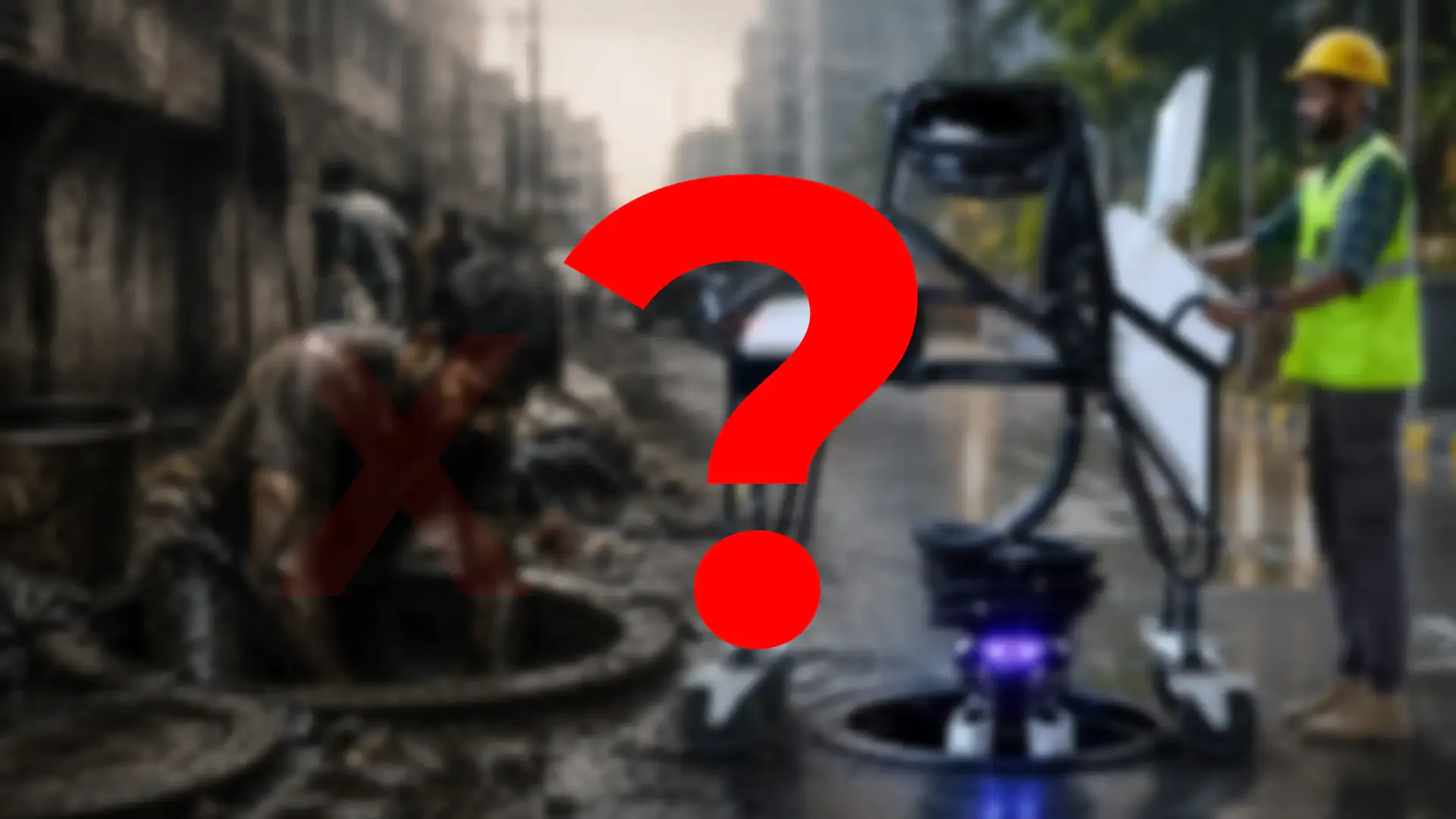
Every nation is ultimately defined not only by the industries it builds, but also by the work it asks its people to do. In India, millions of workers perform tasks that remain largely invisible to society yet are fundamental to keeping cities functional and economies moving. They enter confined spaces beneath urban infrastructure, inspect hazardous industrial environments, handle dangerous waste, and work in conditions where the margin for error is painfully small. These jobs are essential. They are also among the country's most dangerous. The uncomfortable truth is that many of these occupations continue to expose workers to risks that modern technology is increasingly capable of eliminating. Every accident in a sewer, every worker entering a toxic environment, and every injury in a hazardous industrial setting raises a question that has become difficult to ignore: In an era of artificial intelligence and autonomous systems, should human beings still be performing work that places their lives in preventable danger? The question is no longer technological. It is societal. And robotics may hold one of the most important answers.
Dangerous Work Has Always Driven Technological Progress
History reveals a recurring pattern.
Mining became safer through mechanized equipment. Manufacturing transformed through industrial automation. Aviation reduced human exposure to risk through advanced control systems and autonomous technologies.
Societies consistently turn to innovation when certain forms of work become too dangerous, too repetitive, or too physically demanding for human beings.
India stands at a similar moment.
Rapid urbanization, expanding infrastructure networks, industrial growth, and increasing environmental pressures are generating new operational challenges. At the same time, expectations around worker safety and dignity are changing.
Yet the real significance lies elsewhere.
This transition is not merely about improving efficiency.
It is about redefining which occupational risks society considers acceptable.
The Human Cost Hidden Beneath Critical Infrastructure
Some of India's most dangerous jobs exist in places that most people never see.
Underground sewer networks.
Industrial tanks.
Hazardous waste environments.
Confined spaces with limited visibility and uncertain atmospheric conditions.
These environments combine multiple risks simultaneously. Toxic gas exposure, oxygen deficiency, biological contaminants, structural instability, and emergency rescue challenges often coexist in ways that make even routine operations unpredictable.
The implications extend far beyond occupational safety.
Every hazardous job affects families, communities, healthcare systems, and broader social development.
When essential infrastructure depends upon workers repeatedly facing life-threatening environments, the issue becomes larger than labor conditions.
It becomes a question of national priorities.
Robotics Is Expanding Human Capability, Not Replacing Humanity
Public discussions surrounding robotics frequently focus on employment displacement.
But the larger shift is something entirely different.
The most meaningful applications of robotics are emerging precisely where human exposure should be minimized.
Inspection robots are entering confined spaces that are difficult or dangerous to access. Remote-operated systems are performing maintenance activities in hazardous environments. Autonomous robots are increasingly monitoring industrial assets, pipelines, and critical infrastructure.
These technologies are not eliminating human participation.
They are redefining it.
Workers become operators, supervisors, analysts, and decision-makers rather than direct participants in dangerous environments.
This distinction matters enormously.
Automation in hazardous occupations is fundamentally different from automation designed solely around productivity gains.
Its objective is protection.
Sanitation May Become India's Defining Robotics Opportunity
Perhaps nowhere is this transformation more significant than sanitation.
Urban sewer networks represent one of the most critical yet challenging aspects of public infrastructure management. Maintenance activities frequently involve environments that pose substantial risks to human health and safety.
For decades, mechanization remained limited.
Today, that reality is changing.
Robotic systems are increasingly capable of inspecting underground infrastructure, removing blockages, monitoring conditions, and supporting maintenance activities remotely.
Yet the real significance lies elsewhere.
Few countries possess an opportunity to demonstrate public-impact innovation at such scale.
Japan built robotics leadership through industrial precision.
India may build robotics leadership through technologies designed to protect human dignity while addressing large-scale infrastructure challenges.
This possibility extends far beyond sanitation.
It represents a fundamentally different model of technological leadership.
The Rise of Hazardous Environment Robotics
The applications are expanding rapidly.
Inspection robots are increasingly being deployed in energy facilities, manufacturing plants, industrial tanks, and utility infrastructure. Autonomous systems can operate in environments characterized by extreme temperatures, toxic exposure, structural complexity, and operational uncertainty.
These technologies generate benefits that extend beyond immediate safety improvements.
Continuous monitoring becomes possible.
Preventive maintenance becomes more practical.
Data-driven decision-making becomes increasingly achievable.
Infrastructure itself becomes more resilient.
This is where the conversation becomes more important.
The future of dangerous work is not simply about replacing physical labor.
It is about creating entirely new operating models where intelligence, automation, and human expertise function together.
Technology Alone Will Not Solve the Problem
The belief that robotics automatically solves dangerous work challenges oversimplifies reality.
Successful deployment requires ecosystems.
Policy support matters.
Procurement frameworks matter.
Operator training matters.
Long-term maintenance capabilities matter.
Most importantly, social acceptance matters.
The transition from hazardous manual processes toward robotics-enabled operations requires institutions capable of adopting and sustaining technological change.
The implications extend far beyond engineering.
This is simultaneously an infrastructure challenge, a governance challenge, and a workforce transformation challenge.
Technology can create possibilities.
Systems determine whether those possibilities become reality.
The Future of Work May Be Defined by What Humans No Longer Need to Do
Every industrial revolution has altered the relationship between people and work.
The next transformation may be defined not merely by new jobs that emerge but by dangerous jobs that disappear.
This possibility carries profound significance.
A society advances when it reduces unnecessary human suffering through innovation.
A city becomes smarter when its infrastructure protects the people who maintain it.
A nation demonstrates technological maturity when it directs innovation toward solving deeply human challenges.
Can robotics solve India's most dangerous jobs?
Not entirely.
Dangerous environments will continue to exist. Complex infrastructure will continue to require human expertise, judgment, and intervention.
But robotics can fundamentally transform how those environments are managed.
It can significantly reduce exposure to preventable hazards.
It can shift workers away from dangerous physical conditions toward higher-value supervisory roles.
It can make essential services safer, more resilient, and more humane.
And perhaps that is the most important insight of all.
The future of robotics in India is not simply a story about machines becoming more intelligent.
It is a story about human societies deciding that certain forms of suffering are no longer acceptable when better alternatives exist.
Because the ultimate purpose of technological progress is not merely building smarter machines.
It is building a world where fewer people are asked to risk their lives simply to keep society functioning.
Related Blogs

Hazardous-Environment Robotics: Where Physical AI Meets India's Sanitation and Refinery Safety Crisis
At the India AI Impact Summit 2026 in New Delhi, EY India demonstrated “Scout,” a companion robot combining digital twins, robotics, and physical AI to help refinery workers track hazardous pipeline alerts that overwhelm small monitoring teams. It's a compelling demo. But in India, this isn't a preview of the future — it's already a deployed industry, with a body count that makes the case for it.

India’s Robotics Revolution: Innovation Beyond Software
For much of the past two decades, India's innovation story has been synonymous with software. The country became a global technology powerhouse by building expertise in IT services, digital platforms, and enterprise software. That legacy remains a remarkable achievement, but a quieter transformation is now taking shape—one driven not by code alone, but by machines capable of interacting with the physical world. This shift marks the rise of next-generation robotics, where engineering, artificial intelligence, advanced electronics, and intelligent sensing converge to solve problems that software alone cannot address. As industries modernise and infrastructure grows more complex, India's next wave of innovation is increasingly being built in laboratories, manufacturing facilities, and robotics research centres.

Scaling Deep-Tech Innovation: From Research to Commercialisation
Brilliant engineering ideas rarely fail because they lack technical merit. More often, they struggle to cross the difficult bridge between laboratory success and large-scale deployment. Building a working prototype is an achievement. Transforming that prototype into a reliable product that industries trust, regulators approve, and customers adopt is an entirely different challenge. This transition is where every deep tech startup is tested. Unlike software ventures that can iterate rapidly with minimal physical constraints, deep-tech companies must navigate complex engineering, manufacturing, certification, funding, and market adoption simultaneously. As India strengthens its innovation ecosystem, the ability to commercialise advanced technologies may become just as important as inventing them.