
Artificial Intelligence in Industry: India's Next Leap
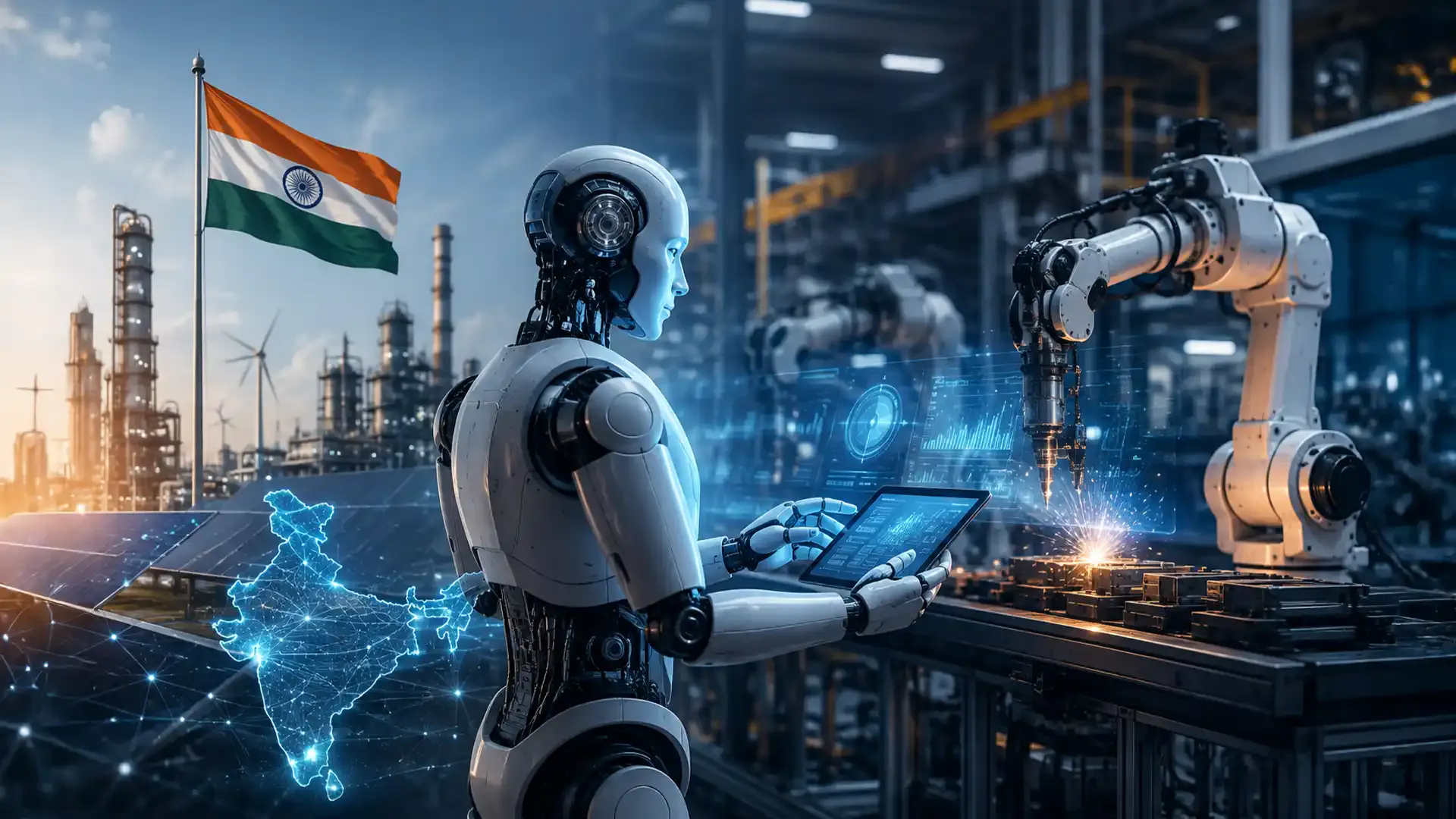
India's industrial ambitions have never been more expansive. The country is strengthening its manufacturing base, modernising critical infrastructure, investing in digital public systems, and positioning itself as a global engineering hub. Yet behind these developments lies a less visible transformation—one that will determine how competitive Indian industries become over the next decade. The conversation is no longer about whether industries should adopt artificial intelligence or robotics. It is about how effectively these technologies can solve real operational challenges, improve decision-making, and create safer, more resilient industrial ecosystems. As industries confront increasing complexity, AI and robotics are becoming foundational capabilities rather than emerging technologies.
India's Next Industrial Leap Will Be Intelligence-Driven
Every industrial revolution has been defined by a technological shift.
Steam mechanised production.
Electricity enabled mass manufacturing.
Digital systems introduced automation.
The next phase is different because it combines physical machines with intelligent decision-making.
Robots are no longer limited to repetitive actions, while artificial intelligence is no longer confined to analysing spreadsheets or generating reports. Together, they allow industrial systems to observe, interpret, learn, and respond to changing environments with unprecedented speed and accuracy.
For India's industrial sector, this convergence represents a strategic opportunity to enhance productivity while strengthening operational resilience.
From Automation to Autonomous Operations
Traditional automation follows predefined instructions.
Intelligent automation adapts.
Modern robotic systems equipped with artificial intelligence can analyse sensor data, recognise visual patterns, detect anomalies, optimise workflows, and support engineering decisions in real time.
These capabilities are particularly valuable in environments where conditions change continuously, including manufacturing facilities, oil and gas installations, mining operations, public utilities, logistics networks, and urban infrastructure.
Instead of waiting for failures to occur, AI-powered systems identify early warning signs, allowing organisations to intervene before operational disruptions escalate.
The result is not simply faster operations.
It is better decision-making across the entire industrial lifecycle.
Infrastructure Is Becoming a Digital Asset
Industrial infrastructure generates enormous volumes of operational data.
Pipelines, production equipment, inspection systems, electrical networks, wastewater facilities, and transportation assets continuously produce information through sensors, cameras, maintenance records, and operational logs.
Historically, much of this data remained underutilised.
Artificial intelligence is changing that.
Machine learning algorithms can identify correlations that would be difficult to detect manually, while predictive analytics help engineering teams anticipate maintenance requirements, optimise asset utilisation, and improve infrastructure reliability.
Industrial assets are increasingly managed not only through physical inspections but also through continuous digital intelligence.
AI Is Reshaping Industrial Safety
Safety has traditionally depended on engineering controls, operational procedures, and human expertise.
These remain essential.
What artificial intelligence adds is the ability to identify hazards before they become incidents.
AI-enabled vision systems can detect unsafe operating conditions, monitor compliance with safety protocols, recognise equipment anomalies, and support remote inspections in hazardous environments.
When combined with robotics, dangerous tasks that previously required direct human intervention can often be performed remotely.
This shift is particularly significant in sectors such as mining, oil and gas, utilities, wastewater management, and heavy manufacturing, where occupational risks remain substantial.
Rather than replacing experienced professionals, intelligent systems expand their ability to make informed decisions while reducing unnecessary exposure to hazardous environments.
Manufacturing Competitiveness Depends on Intelligent Systems
Global manufacturing is becoming increasingly data-driven.
Customers expect higher quality, shorter delivery cycles, greater flexibility, and improved sustainability.
Meeting these expectations requires production systems capable of learning and continuously improving.
Factories equipped with robotics and artificial intelligence can optimise production scheduling, improve quality control, reduce material waste, predict equipment failures, and enhance energy efficiency.
These capabilities strengthen India's position within global manufacturing supply chains while enabling industries to compete on innovation rather than labour costs alone.
The competitive advantage increasingly belongs to organisations that can transform operational data into actionable intelligence.
Public Infrastructure Is Following the Same Path
The impact of AI extends beyond manufacturing.
Municipal infrastructure, transportation systems, water management, and public utilities are also adopting intelligent technologies.
Robotic inspection platforms supported by artificial intelligence can assess underground pipelines, drainage systems, bridges, tunnels, and utility corridors while collecting detailed infrastructure data.
This information enables predictive maintenance, improves public service reliability, and supports more effective allocation of municipal resources.
As India's cities continue to expand, intelligent infrastructure management will become just as important as infrastructure construction itself.
Innovation Requires More Than Algorithms
Artificial intelligence alone cannot transform industry.
Its success depends on integration with engineering expertise, domain knowledge, reliable data, cybersecurity, and operational discipline.
Industrial AI differs fundamentally from consumer AI.
Algorithms must operate within safety-critical environments where reliability, explainability, and regulatory compliance are essential.
This is why successful implementations combine software intelligence with robust mechanical engineering, advanced sensing technologies, and well-defined operational processes.
Technology creates possibilities.
Engineering ensures those possibilities perform consistently under real-world conditions.
Indigenous Innovation Is Strengthening India's Industrial Ecosystem
India's technology landscape has matured rapidly over the past decade.
Engineering-led companies are increasingly developing solutions tailored to the country's unique industrial and infrastructure challenges instead of relying exclusively on imported technologies.
One example is Genrobotics, whose work demonstrates how robotics integrated with artificial intelligence can improve safety and operational efficiency in hazardous infrastructure environments. Their approach reflects a broader trend in Indian innovation—developing technologies that address practical engineering problems while contributing to long-term industrial capability.
This emphasis on indigenous research and development strengthens both technological self-reliance and global competitiveness.
The Industries That Learn Fastest Will Lead Tomorrow
Every major industrial transition rewards organisations that adapt before change becomes unavoidable.
The convergence of robotics and artificial intelligence is creating precisely such a moment.
Companies that invest in intelligent inspection, predictive maintenance, digital infrastructure management, and AI-enabled decision support are building capabilities that extend far beyond operational efficiency. They are creating organisations capable of responding to uncertainty with greater speed, accuracy, and resilience.
India's industrial future will not be defined solely by larger factories, stronger infrastructure, or increased production capacity. It will be shaped by how effectively industries transform information into intelligence and intelligence into action.
The next chapter of industrial growth belongs to organisations that understand a simple but powerful reality: the most valuable machines of the future will not merely automate work—they will continuously help people make better decisions, unlocking safer operations, stronger infrastructure, and a more competitive industrial economy.
Related Blogs

Hazardous-Environment Robotics: Where Physical AI Meets India's Sanitation and Refinery Safety Crisis
At the India AI Impact Summit 2026 in New Delhi, EY India demonstrated “Scout,” a companion robot combining digital twins, robotics, and physical AI to help refinery workers track hazardous pipeline alerts that overwhelm small monitoring teams. It's a compelling demo. But in India, this isn't a preview of the future — it's already a deployed industry, with a body count that makes the case for it.

India’s Robotics Revolution: Innovation Beyond Software
For much of the past two decades, India's innovation story has been synonymous with software. The country became a global technology powerhouse by building expertise in IT services, digital platforms, and enterprise software. That legacy remains a remarkable achievement, but a quieter transformation is now taking shape—one driven not by code alone, but by machines capable of interacting with the physical world. This shift marks the rise of next-generation robotics, where engineering, artificial intelligence, advanced electronics, and intelligent sensing converge to solve problems that software alone cannot address. As industries modernise and infrastructure grows more complex, India's next wave of innovation is increasingly being built in laboratories, manufacturing facilities, and robotics research centres.

Scaling Deep-Tech Innovation: From Research to Commercialisation
Brilliant engineering ideas rarely fail because they lack technical merit. More often, they struggle to cross the difficult bridge between laboratory success and large-scale deployment. Building a working prototype is an achievement. Transforming that prototype into a reliable product that industries trust, regulators approve, and customers adopt is an entirely different challenge. This transition is where every deep tech startup is tested. Unlike software ventures that can iterate rapidly with minimal physical constraints, deep-tech companies must navigate complex engineering, manufacturing, certification, funding, and market adoption simultaneously. As India strengthens its innovation ecosystem, the ability to commercialise advanced technologies may become just as important as inventing them.