
Robots Should Take the Most Dangerous Jobs First
We keep asking the wrong question about robots. We ask which jobs they will take: coders, drivers, writers, cashiers. The better question is which jobs they should take first.
We keep asking the wrong question about robots. We ask which jobs they will take: coders, drivers, writers, cashiers. The better question is which jobs they should take first.
The answer is the ones that kill people. Sewers. Septic tanks. Chemical tanks. Flooded drains. The places where a human body was never meant to go. Robots in dangerous jobs shouldn’t be a niche. They should be the industry’s first priority.
In short:
- Nearly 3 million people die every year from work-related accidents and diseases, according to the ILO.
- The most dangerous work is often the least automated, because the people who do it are the least visible.
- The Danger-First Principle: automate work in order of the harm it does to people, not the profit it promises.
Work still kills, everywhere
The International Labour Organization estimates that nearly three million workers die every year from work-related accidents and diseases. That includes 330,000 deaths in workplace accidents alone.
Rich countries aren’t exempt. In the United States, 5,070 workers died from work injuries in 2024, one every 104 minutes. Deaths in building and grounds cleaning and maintenance rose to 356.
In India, 332 sanitation workers died cleaning sewers and septic tanks between January 2021 and June 2026, according to data given to the Lok Sabha. Most of those deaths happened in a confined space no more than a metre wide.
The robotics industry has its priorities upside down
The loudest robotic innovations today are humanoids that dance, warehouse arms that sort parcels and AI robots that fold laundry. They’re impressive engineering, and they will matter.
But look at where the money and attention go, and you’ll see a pattern. We automate first where it’s profitable, then where it’s convenient. Work that is merely deadly comes last, because the people who do it are poor, outsourced and easy to overlook.
Hazardous environment robotics turns that order around. It starts with a simple question: where is a human being in the most danger, and can a machine go there instead?
Danger-first isn’t a new idea. It’s an unfinished one.
We’ve done this before. Bomb disposal teams have sent robots ahead of soldiers and police for decades. Nuclear operators use remote machines inside reactor buildings that no person could safely enter. Deep-sea and space exploration run on robots because humans can’t survive there.
In each case the logic was simple: the danger was obvious, the workers were valued, and someone with a budget cared.
Sanitation and industrial cleaning never got that treatment. The danger is just as real. A sewer can kill as fast as a gas leak. But the people who go down are contract workers on daily wages, not soldiers or engineers. The work never felt urgent to the people who could fund the machines.
The Danger-First Principle finishes the job. It asks for the same standard in every deadly workplace, whoever the worker happens to be.
The Danger-First test: which jobs should robots take first?
Any job that meets three of these four conditions belongs at the front of the automation queue.
- Confined: the worker enters a space built for pipes, waste or machinery, not for people. Sewers, tanks, wells and culverts.
- Toxic: the air, fluid or material can injure or kill. Hydrogen sulphide, methane, chemical vapour, sludge.
- Repetitive: the same dangerous task is done daily, so the risk compounds over a working life.
- Invisible: the worker is low-paid, contracted or uncounted, so deaths don’t change budgets.
Manual sewer cleaning meets all four. So do many industrial tank-cleaning and drain-desilting jobs.
Where robots should go first
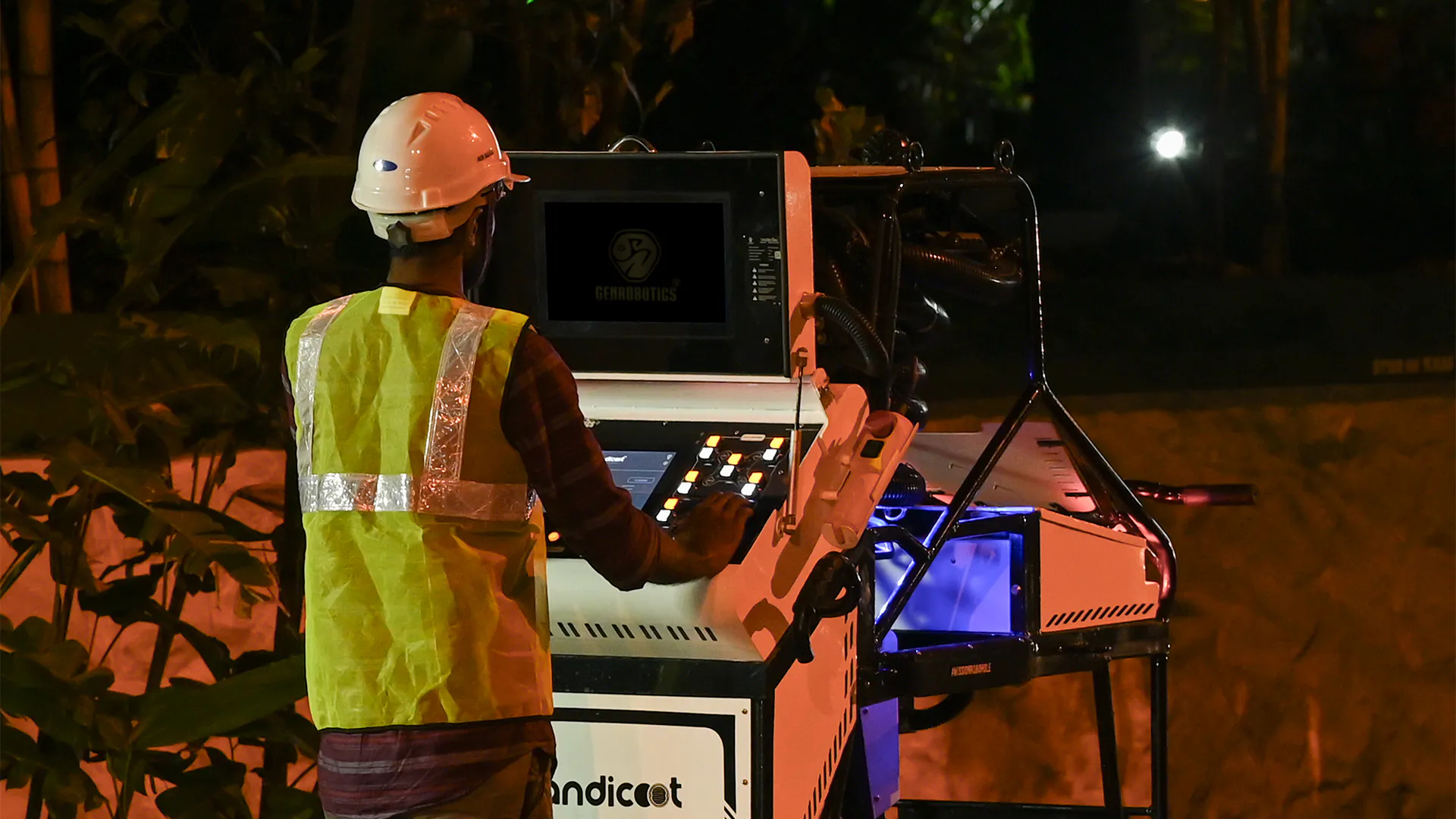
Sewer and manhole cleaning comes first. Toxic gas and drowning in sludge are what kill here. Bandicoot goes into the manhole, removes the waste and reads gas levels, while the operator stays above ground.
Stormwater drains, STP wells and culverts are next. These are confined spaces full of sludge and chemical waste. Wilboar, a tracked rover, clears and inspects these horizontal spaces.
Urban drains and manholes at scale mean repeated entries and constant blockages. G-Mammoth grabs, jets, sucks and inspects, all in one machine.
Canals and waterways carry the risk of drowning among floating and submerged waste. G-Spider, a cable-driven robot, detects and lifts debris without anyone having to stand in the water.
Industrial tanks and tank floor inspection expose workers to chemical vapour and low oxygen. An inspection robot such as Wilboar, built for oil and gas, chemical and pharma sites, surveys and cleans the tank so no one has to enter it.
Bandicoot shows what this looks like at scale. It’s working in 19 states and 3 Union Territories in India, across 120+ cities. Wilboar has gone into high-altitude sewage plants in Leh and, through Indah Water, into Malaysia.
What a danger-first robot has to get right
Building a robot for a lab is one problem. Building one for a 12-metre sewer in a crowded lane is another. Five things decide whether hazardous environment robotics works in the real world.
- The human stays in control, out of harm’s way. The robot enters the danger and the operator doesn’t. Every Genrobotics machine is run from the surface or from outside the tank.
- It fits the space as it actually is. Real manholes are narrow, deep and irregular. Bandicoot reaches up to 12 metres, and its robotic legs brace it inside the shaft.
- It survives the environment. Sewage, water, grit and gas destroy ordinary electronics. Bandicoot is built to IP68, industrial-grade standards, with gas sensors on board.
- The people already doing the job can learn it. If the worker who used to go down can’t run the robot, the robot fails socially even if it works technically. Training is part of the product.
- It produces data. Cameras, gas readings and job logs give cities a record they never had: which manholes block, how often, and how fast they’re cleared. Genrobotics’ G-Crow platform manages this side of operations.
This is where robotics engineering companies in India have an edge. They design for these conditions from the start, not as an afterthought to a factory robot.
The economics: what a death actually costs
The usual argument against robots in dangerous work is cost. A person with a rope is cheaper than a machine. That’s only true if you ignore what happens when things go wrong.
In India, the Supreme Court has set compensation at ₹30 lakh for every sewer death and ₹20 lakh for permanent disability. It has also told authorities to cancel contracts and blacklist agencies when deaths occur. One death can cost a city more than a robot, before you count the investigations, the delays and the public anger.
Then there’s productivity. A robot doesn’t need to wait for the gas to clear, and it doesn’t need to stop after one shaft. It can work every day, in any season, and log every job it does.
The real comparison isn’t a robot against a worker. It’s a robot against the risk of losing that worker. Seen that way, the danger-first job is also the smart investment for robotic automation companies in India and the cities they serve.
“Won’t robots take these jobs away?”
That’s the right worry, and the answer is in how the work changes.
When a city deploys Bandicoot, the sanitation worker who used to climb into the manhole is trained to operate the robot from the surface. More than 1,000 sanitation workers have made that switch. They keep the income and gain a skill. They lose only the risk.
That’s the difference between automation that replaces people and automation that protects them. Danger-first robotics is the second kind.
Why this work is being built in India, for the world
India has both the scale of the problem and the engineering talent to solve it. That combination is producing a different kind of Indian robotics company: one that designs for narrow lanes, low budgets and harsh conditions, then exports what works.
Genrobotics was founded in 2017 in Thiruvananthapuram by four engineers: Vimal Govind MK, Arun George, Nikhil NP and Rashid K. A 2016 sewer accident in Kozhikode that killed three men turned their work toward manual scavenging. Among robotics companies in Kerala, and among robot manufacturers in India more broadly, it’s one of the few built around hazardous work from day one. Its backers include Anand Mahindra and Zoho’s Sridhar Vembu.
Genrobotics products now span sanitation (Bandicoot, Wilboar, G-Mammoth, G-Spider) and medical rehabilitation (G-Gaiter). The idea behind all of them is the same: put the machine where the human is most at risk, or most in need.
This is also where the robotics future in India is most distinctive. Many robotics companies in India compete on factory automation and AI robots. The bigger global opportunity is robots that cities, utilities and industries everywhere need and can afford. That’s the gap an indigenous robot manufacturer is best placed to fill.
What leaders can do now
- Governments: put zero human entry into law, procurement and contracts, not just guidelines.
- Cities and utilities: map every confined-space task and price the cost of a death against the cost of a robot.
- Industry: make hazardous environment robotics part of safety budgets, not innovation budgets.
- Investors: fund robots that save lives at the bottom of the labour market, not only those that save costs at the top.
- Robotics and automation companies in India and beyond: build for the worst job in the room first.
Robots will take many jobs. Let them take the deadly ones first.
Every robot that goes into a sewer is a person who doesn’t. That’s the clearest measure of robotic innovation there is.
Frequently Asked Questions(FAQ)
- What is hazardous environment robotics? Hazardous environment robotics is the design of robots that work in places that are dangerous for people, such as sewers, chemical tanks, mines, canals and disaster zones. The robot enters the confined or toxic space while a human operator controls it from a safe distance.
- Which dangerous jobs should robots take first? Robots should take first the jobs that are confined, toxic, repetitive and done by low-paid or uncounted workers. Manual sewer and septic tank cleaning meets all four. So do many industrial tank-cleaning and drain-desilting jobs.
- What is the Danger-First Principle? The Danger-First Principle, set out by Genrobotics, says work should be automated in order of the harm it does to people, not the profit it promises. It puts robots into the deadliest jobs before the most profitable ones.
- Do robots in dangerous jobs take work away from people? Not when they are deployed well. When Indian cities adopt Genrobotics' Bandicoot, sanitation workers are trained to operate the robot from the surface. More than 1,000 workers have made that switch, keeping their income and losing the risk.
- How many people die from work-related causes each year? The International Labour Organization estimates that nearly 3 million workers die every year from work-related accidents and diseases, including about 330,000 in workplace accidents. In the United States, 5,070 workers died from work injuries in 2024.
- Which Indian robotics company builds robots for hazardous work? Genrobotics, founded in 2017 in Thiruvananthapuram, Kerala, builds robots for hazardous work. Its products include Bandicoot for manholes, Wilboar for drains and tanks, G-Mammoth for drain and manhole cleaning, and G-Spider for canals.
Related Blogs

Can India Become a Global Robotics Leader?
A decade ago, the idea of robots cleaning sewers, assisting rehabilitation therapy, monitoring urban infrastructure, or supporting public healthcare systems in India would have sounded futuristic. Today, some of these technologies are no longer concepts confined to laboratories or global tech conferences. They are entering Indian streets, hospitals, municipalities, and industrial ecosystems in real and measurable ways.

How Robotics Can Prevent Drainage Crises During Monsoon Season
Understanding why urban India floods the way it does requires going underground, quite literally, and examining the state of the infrastructure we rarely think about until it stops working.

Extreme Environment Robotics in India Explained
When we think about robotics, we often picture controlled environments and predictable systems. But in India, robotics is evolving in places that are anything but controlled.