
Industrial Robotics Misconceptions You Should Know

When people hear the word robotics, they often imagine machines working alone, performing tasks perfectly, and replacing human effort entirely. But that picture is incomplete.
When people hear the word robotics, they often imagine machines working alone, performing tasks perfectly, and replacing human effort entirely. But that picture is incomplete.
In reality, industrial robotics, hazardous environment robotics, and medical robotics are built to solve practical problems in very different environments. This article explains five common misconceptions about robotics and what actually happens in real world applications.
What are industrial robotics, hazardous environment robotics, and medical robotics?
Industrial robotics refers to robotic systems used in industries such as manufacturing, infrastructure, and energy.
Hazardous environment robotics focuses on systems designed to operate in unsafe conditions like toxic spaces, confined environments, or high risk industrial zones.
Medical robotics involves robotic systems that assist healthcare professionals in surgery, rehabilitation, and patient care.
All three share a common goal. To improve safety, precision, and consistency in environments where human effort alone can be limited.
Are robots designed to replace humans?
No, robots are designed to support human work, not replace it.
This is one of the most common misconceptions. In industrial robotics, machines assist with repetitive or physically demanding tasks. In hazardous environment robotics, robots are sent into areas where human safety is at risk.
In medical robotics, the role becomes even more sensitive. Robots assist doctors and therapists by improving precision and consistency during procedures and rehabilitation.
Across all three fields, humans remain responsible for:
- Decision making
- Supervision
- Clinical or operational judgment
Robots handle repetition, risk, and physical strain.
Can robots operate completely on their own?
No, most robotic systems require human control and supervision.
While automation has advanced, full independence is rare. Industrial robotics systems are monitored by operators who guide performance and respond to unexpected conditions.
In hazardous environment robotics, remote operation is often essential. Engineers control machines from safe locations using real time data.
In medical robotics, human involvement is even more critical. Doctors and therapists guide robotic systems during surgery or rehabilitation, ensuring patient safety at every step.
Robots follow programmed instructions. Humans provide context and decision making.
Do robots always work perfectly?
No, robots are influenced by their environment and operating conditions.
It is easy to assume that robots perform with complete accuracy at all times. However, real world conditions introduce variability.
In industrial robotics, factors such as wear and calibration affect performance. In hazardous environments, challenges include poor visibility, unstable surfaces, and unpredictable materials.
In medical robotics, precision is extremely important, but systems are still carefully monitored to ensure safety and accuracy during use.
Reliability is achieved through:
- Continuous monitoring
- Safety mechanisms
- Controlled environments where required
- Human oversight
Robots are built to manage complexity, not eliminate it entirely.
Is robotics only about machines?
No, robotics is a combination of hardware, software, and data systems.
A robotic system is not just a machine. It is an integration of multiple components working together.
These include:
- Sensors that collect environmental or patient data
- Control systems that process information
- Software that determines system behavior
- Mechanical systems that execute movement
In hazardous environment robotics, this integration helps the system navigate dangerous conditions safely.
In medical robotics, it allows precise tracking of patient movement and controlled execution of therapy or procedures.
The physical machine is only one part of a larger system.
Is robotics only useful in large industries?
No, robotics is used across multiple sectors beyond large scale industries.
While industrial robotics began in manufacturing, its applications have expanded widely. Today, robotics is used in:
- Sanitation and waste management
- Healthcare and rehabilitation
- Infrastructure inspection and maintenance
- Oil and gas operations
Medical robotics plays a key role in hospitals and rehabilitation centers, helping patients recover mobility and assisting clinicians in delivering better care.
Hazardous environment robotics is used wherever human exposure to risk needs to be minimized.
The value of robotics depends on the problem it solves, not the size of the industry.
What do these misconceptions overlook?
These misconceptions often come from viewing robotics in extremes.
In reality, robotics is built around real challenges and practical needs.
Across industrial robotics, hazardous environment robotics, and medical robotics, systems are designed to:
- Improve safety in high risk environments
- Deliver consistent performance under pressure
- Support human expertise rather than replace it
- Adapt to complex and changing conditions
Each field applies the same core idea in different ways. Use machines to handle difficulty while humans guide outcomes.
Why is it important to understand robotics correctly?
Understanding robotics helps organizations and individuals make better decisions about adopting these technologies.
Misconceptions can create unrealistic expectations or hesitation. When we understand how robotics actually works, we see its purpose more clearly.
Robotics is not about removing human involvement. It is about enhancing it.
Robotics is not about perfection. It is about consistency and reliability.
Robotics is not about replacing expertise. It is about supporting it with better tools.
Conclusion
Industrial robotics, hazardous environment robotics, and medical robotics are often misunderstood, but their role is practical and essential.
They are designed to work alongside humans, manage risk, and operate in environments where manual effort alone is not enough.
The key takeaway is simple.
Robotics is not about what machines can do alone. It is about how humans and machines work together to solve complex problems safely, efficiently, and effectively.
FAQ
What is industrial robotics?
Industrial robotics refers to robotic systems used in industries like manufacturing and infrastructure to improve efficiency, precision, and safety.
What is hazardous environment robotics?
Hazardous environment robotics involves robots designed to operate in dangerous conditions such as toxic areas, confined spaces, or high risk industrial zones.
What is medical robotics?
Medical robotics refers to robotic systems used in healthcare to assist doctors and therapists in surgery, rehabilitation, and patient care.
Do robots replace human workers?
No, robots support human workers by handling repetitive or risky tasks while humans focus on decision making and supervision.
Are robotic systems fully autonomous?
Most robotic systems are not fully autonomous and require human monitoring and control, especially in complex environments like healthcare and hazardous industries.
Related Blogs
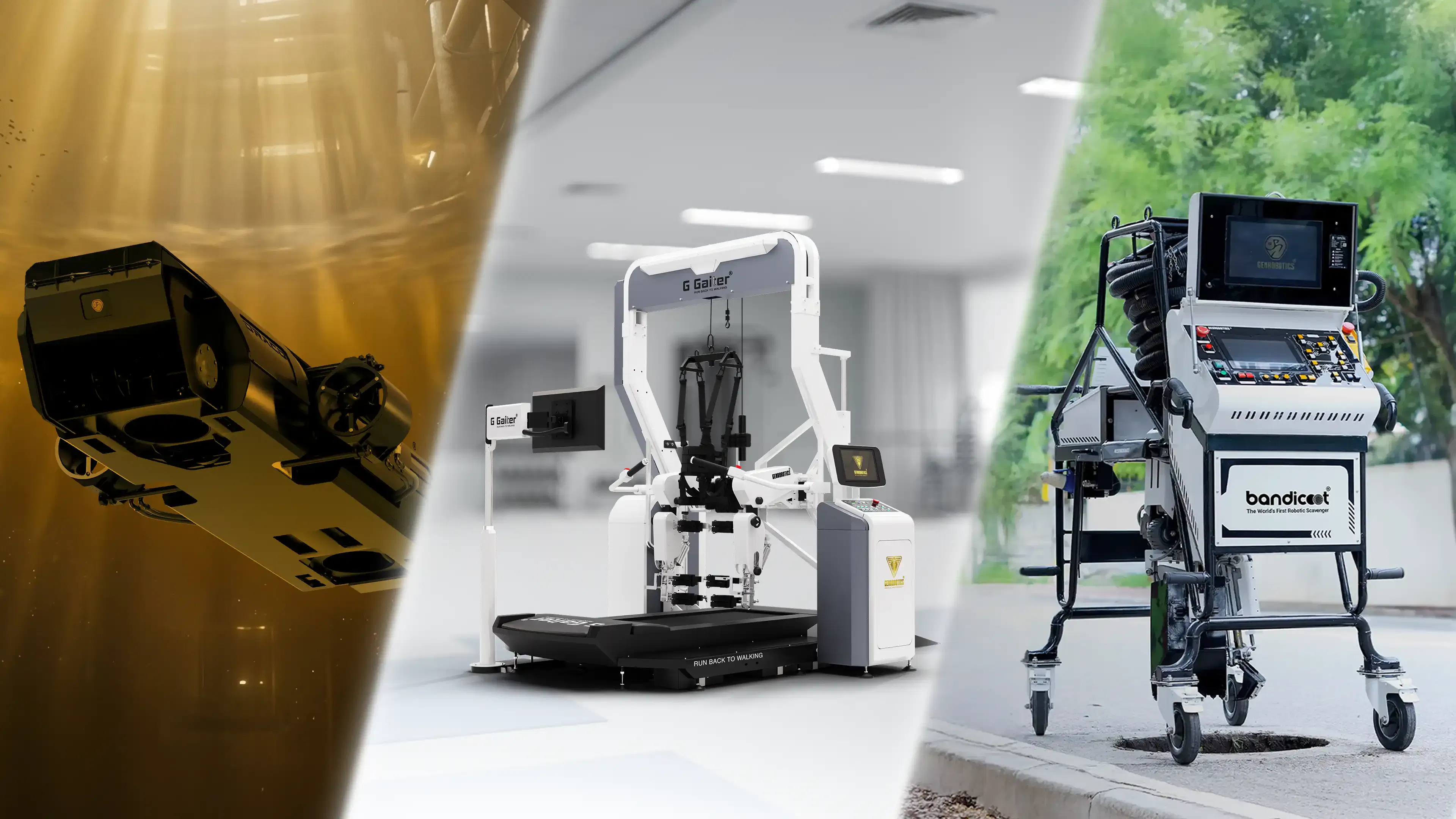
Extreme Environment Robotics in India Explained
When we think about robotics, we often picture controlled environments and predictable systems. But in India, robotics is evolving in places that are anything but controlled.
Robotics Startups in India Using AI and Automation
India’s startup ecosystem is evolving beyond software platforms and digital applications. A new generation of founders is building technologies that interact directly with the physical world. This shift has led to the rise of the robotics startup India ecosystem, where engineers and innovators are developing machines designed to solve real industrial and societal problems.