
G-SPIDER Canal Cleaning: The Future of Urban Sludge Management
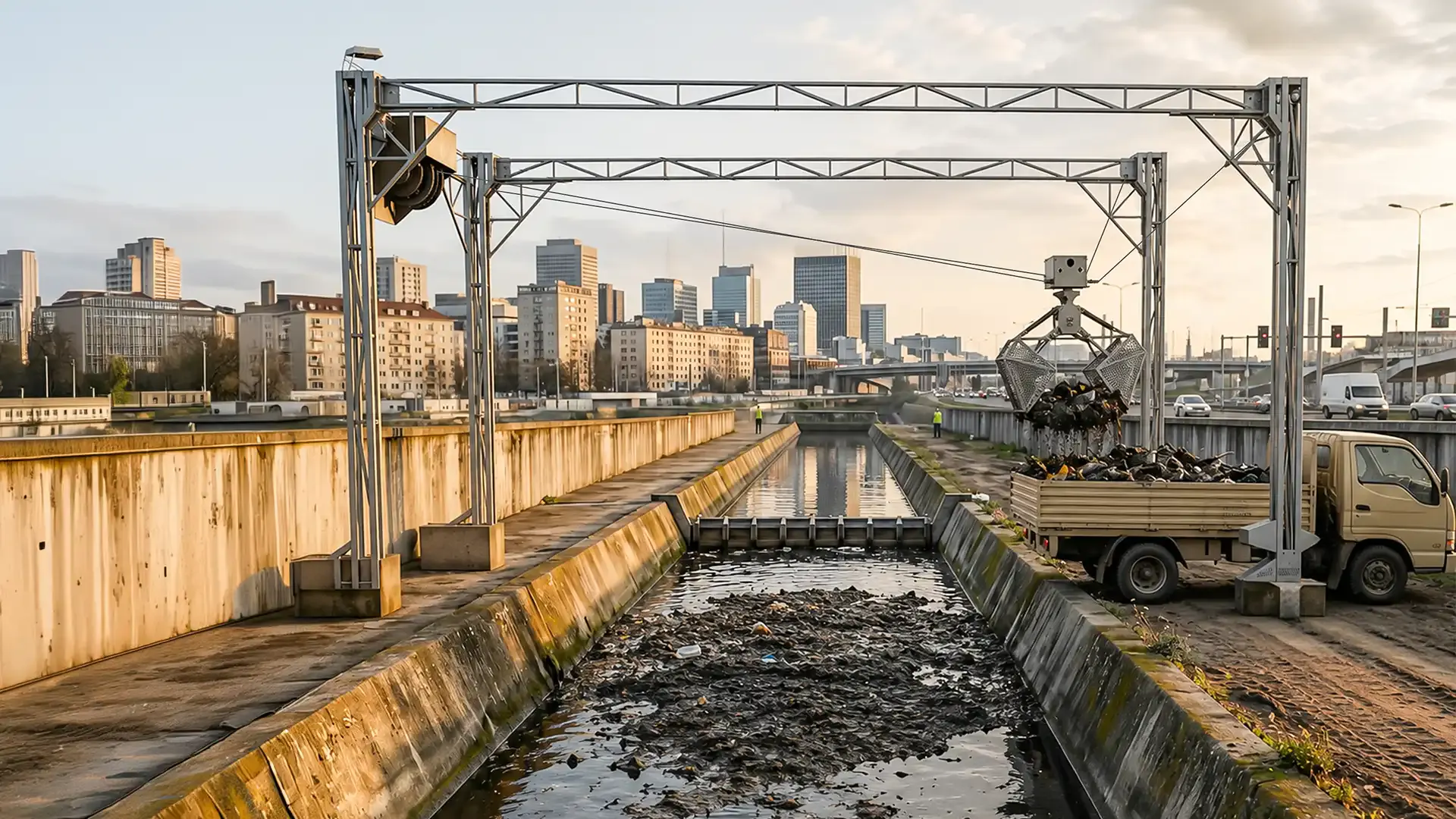
Urban sanitation has traditionally been reactive. A drain gets blocked, a canal accumulates waste, water flow slows, and cleaning teams are sent in to clear the problem.
From Drain Cleaning to Canal Maintenance: The Evolution of Autonomous Urban Sludge Management
Urban sanitation has traditionally been reactive. A drain gets blocked, a canal accumulates waste, water flow slows, and cleaning teams are sent in to clear the problem.
But as cities become denser, drainage networks become more complex and extreme weather puts greater pressure on urban infrastructure, this model is changing.
The next generation of sanitation is moving beyond periodic drain cleaning towards continuous, technology-led maintenance. Robotics, artificial intelligence, machine vision and remote operations are opening a new chapter in how cities manage difficult and hazardous environments.
This evolution can be seen in the emergence of solutions such as G-SPIDER, an AI-powered robotic canal-cleaning system developed by Genrobotics for challenging waterways and confined environments. Built around a Cable-Driven Parallel Robotics architecture, G-SPIDER is designed to detect, assess and remove waste without requiring humans to enter dangerous canal sections.
Why Urban Drainage Management Needs a New Approach
Urban drainage systems are under increasing pressure.
Plastic waste, vegetation, sediment, silt and other debris can accumulate in drains, canals and waterways, restricting water movement and making routine maintenance more difficult. In some locations, the physical environment itself becomes the biggest challenge.
Covered canals, narrow drainage channels, limited access, continuous water flow and contaminated environments can make manual intervention dangerous or impractical. This creates a fundamental problem for municipalities: how can essential infrastructure be maintained without repeatedly exposing workers to hazardous spaces?
The answer is increasingly moving towards mechanization and robotics. Rather than asking workers to enter the environment, autonomous and remotely operated systems can be designed to take the machine into the environment.
From Robotic Sewer Inspection to Robotic Intervention
Robotics in urban sanitation did not begin with autonomous cleaning.
One of the important stages in the evolution has been robotic sewer inspection. Camera-equipped systems, sensors and mobile robotic platforms can enter pipelines and confined infrastructure to identify blockages, structural damage and other maintenance requirements without requiring direct human entry.
Recent research into robotic sewer inspection highlights the growing role of multi-sensor systems, intelligent control and data-driven infrastructure assessment.
The next step is intervention. Instead of simply identifying a problem, robotic systems can increasingly be designed to perform the physical task required to address it.
This changes the role of robotics in municipal infrastructure from inspection technology to an active maintenance platform.
The result is a more complete model:
- Detecting the problem.
- Assess the environment.
- Reach the difficult area.
- Remove the obstruction or waste.
- Monitor the outcome.
- Repeat the process when required.
This is where automated urban sludge management begins to move from a concept towards an operational model.
What Is Automated Urban Sludge Management?
Automated urban sludge management refers to the use of robotics, sensors, artificial intelligence and mechanical systems to monitor, manage and remove accumulated material from urban drainage and waterway infrastructure with reduced dependence on manual intervention.
In practice, this can include the management of silt, sludge, floating waste, organic matter and mixed debris in drains, canals and other difficult-to-access environments.
The objective is not simply to make cleaning faster. It is to make urban infrastructure maintenance safer, more systematic and more responsive.
For smart cities, this distinction matters.
A drainage network cannot be treated as a system that only needs attention after a blockage becomes a visible problem. It needs to be monitored and maintained as critical urban infrastructure.
G-SPIDER Canal Cleaning: Bringing Robotics into Waterways
G-SPIDER represents this transition from conventional cleaning to robotic waterway maintenance.
The system was developed by Genrobotics to operate in complex canal environments where human access can be difficult or unsafe.
Its architecture combines cable-driven robotics with AI-enabled vision and sensor intelligence to support waste detection, positioning and robotic collection. Instead of relying entirely on manual entry, the robotic system can be deployed from outside the hazardous environment and controlled remotely. This approach has several advantages.
The first is worker safety. Hazardous canal environments can be accessed without putting sanitation workers directly inside the contaminated space.
The second is precision. Machine vision and sensor systems can help identify waste and guide robotic movement.
The third is repeatability. A robotic platform can be integrated into structured cleaning and monitoring processes rather than being limited to one-off intervention.
The fourth is scalability. The same principle can be adapted to other difficult urban waterways and infrastructure environments.
A Real-World Example: Amayizhanchan Canal
The transition from concept to real-world deployment is already visible in Thiruvananthapuram. G-SPIDER was deployed at the Amayizhanchan Canal, including a difficult stretch beneath the Thampanoor railway premises.
The location presented restricted vertical clearance, continuous water flow, limited equipment access and no safe human entry points, making conventional cleaning particularly difficult. Between 4 February and 16 June 2026, the deployment completed 56 waste collection cycles and removed an estimated 168 tones of waste from the canal.
More importantly, the operation highlighted a challenge that exists far beyond a single canal: waste does not stop accumulating after one cleaning cycle.
Fresh waste can continue to enter waterways through runoff, vegetation, floating debris and improper disposal.
That means urban waterway maintenance cannot depend only on periodic removal. It requires a more continuous approach to monitoring, interception and intervention.
From Cleaning to Flood Mitigation
Canal cleaning is not only a sanitation issue. Urban waterways are also part of a city's drainage infrastructure.
When waste and accumulated material obstruct water movement, the ability of the system to handle heavy rainfall can be affected. This is why robotic canal maintenance has implications for urban flood mitigation.
A cleaner and better-maintained waterway can support more effective water movement, while early identification and removal of accumulated debris can reduce the likelihood of drainage pathways becoming severely obstructed.
Robotics alone cannot eliminate urban flooding. Flood resilience depends on a much larger system that includes drainage design, stormwater management, waste control, watershed planning and timely infrastructure maintenance.
However, autonomous canal cleaning can become an important operational layer within that system. For smart cities, the opportunity is to connect these layers:
- Sensors can identify conditions.
- Robotic systems can reach difficult areas.
- AI can support detection and decision-making.
- Municipal teams can use operational data to plan maintenance.
The result is a move towards infrastructure that is not only cleaned, but continuously managed.
Why Confined-Space Robotics Matters
The principle behind autonomous canal maintenance extends beyond canals.
Cities contain thousands of spaces that are difficult, hazardous or inefficient for people to access: sewers, stormwater drains, pumping stations, underground passages, treatment infrastructure and other confined environments.
This makes confined-space robotics a broader urban infrastructure category. The goal is not to replace people.
The goal is to remove people from tasks where exposure to toxic gases, contaminated water, unstable surfaces, restricted movement or other hazards can create unnecessary risk.
Machines can take on the dangerous physical environment while people remain responsible for supervision, planning, decision-making and system management.
That is the larger transformation taking place across robotic sanitation.
The Future of Urban Waterway Maintenance
The future of urban sanitation will not be defined by a single robot or a single cleaning method.
It will be defined by connected systems.
Imagine a city where drainage infrastructure is continuously monitored, waste hotspots are identified through sensors and AI, robotic systems are deployed before blockages become critical, and maintenance teams receive actionable data instead of relying entirely on manual inspection.
That is the direction in which automated urban sludge management is evolving. The progression is clear:
- From manual cleaning to mechanised cleaning.
- From mechanised cleaning to robotic intervention.
- From robotic intervention to intelligent monitoring.
- And ultimately, from reactive maintenance to predictive urban infrastructure management.
G-SPIDER is part of this larger transition.
Its significance lies not only in the ability to remove waste from a difficult canal, but in demonstrating how robotics can become part of the everyday management of urban infrastructure.
Building Safer, Smarter Cities with Robotics
The evolution of sanitation technology is ultimately about more than cleaning. It is about protecting workers, strengthening public infrastructure and helping cities respond to increasingly complex environmental challenges.
G-SPIDER demonstrates what happens when AI and robotics are designed around a real urban problem: a difficult environment that still needs continuous maintenance, but where human entry should no longer be the default solution.
From robotic sewer inspection to autonomous canal cleaning, the future of sanitation is becoming increasingly intelligent, remote and data-driven.
The city of the future will need infrastructure that can be monitored, maintained and restored with greater precision.
And increasingly, robots will be part of that infrastructure.
Frequently Asked Questions
What is G-SPIDER canal cleaning?
G-SPIDER is an AI-powered robotic canal-cleaning system developed by Genrobotics for challenging waterway environments. It uses a Cable-Driven Parallel Robotics architecture along with vision and sensor systems to detect and remove waste while reducing the need for human entry into hazardous areas.
How does robotic sewer inspection improve urban sanitation?
Robotic sewer inspection allows cameras, sensors and robotic systems to assess confined infrastructure without requiring workers to enter hazardous environments. This can support earlier identification of blockages, structural problems and maintenance requirements.
What is automated urban sludge management?
Automated urban sludge management uses robotics, AI, sensors and mechanized systems to monitor and manage accumulated sludge, silt, waste and debris in urban drainage and waterway infrastructure.
Can robotic canal cleaning help reduce urban flood risk?
Robotic canal cleaning can support flood resilience by helping municipalities maintain drainage waterways and remove accumulated waste and debris that may restrict water flow. However, flood mitigation requires a wider combination of infrastructure planning, drainage management, waste control and maintenance.
Why are autonomous robots important for smart cities?
Autonomous robots can perform difficult infrastructure tasks with reduced human exposure to hazardous environments while providing opportunities for more consistent, data-driven and scalable maintenance operations.